


What oven and range problems do we repair?
We repair heating faults, temperature problems, burners and igniters, door and lock faults, and control faults on gas, electric, and dual-fuel ovens and ranges.
| Symptom | Likely cause | What the technician does |
|---|---|---|
| Oven will not heat (electric) | A failed bake element, a bad temperature sensor, a failed relay or control board, or a blown thermal fuse | Tests the element and the sensor with a meter, then the relay, the fuse, and the control board |
| Oven will not heat (gas) | A weak or failed igniter, a failed safety valve, or a bad control board | Measures the igniter's current, since a weak igniter cannot open the gas valve, then tests the valve and the board |
| Temperature is off, or it never reaches the setting | A drifting temperature sensor, a weak element, a failing control board or relay, or, less often, a worn door seal | Checks the temperature with a test thermometer, then tests the sensor, the element, the control, and the door seal |
| Oven runs too hot, or the heat will not shut off | A failed temperature sensor, a relay stuck closed, or a control board fault | Checks the true temperature with a test thermometer, then tests the sensor, the relay, and the board |
| Uneven baking | A failed convection fan motor, a weak bake element, or a door that does not seal | Tests the fan and the element and checks the door seal |
| Broiler does not work | A failed broil element (electric) or broil igniter (gas), or a control fault | Tests the element or the igniter and the control |
| Electric burner not heating | A failed coil element, a worn burner receptacle, or a failed infinite switch | Swaps in a good element to test, checks the receptacle, then tests the switch |
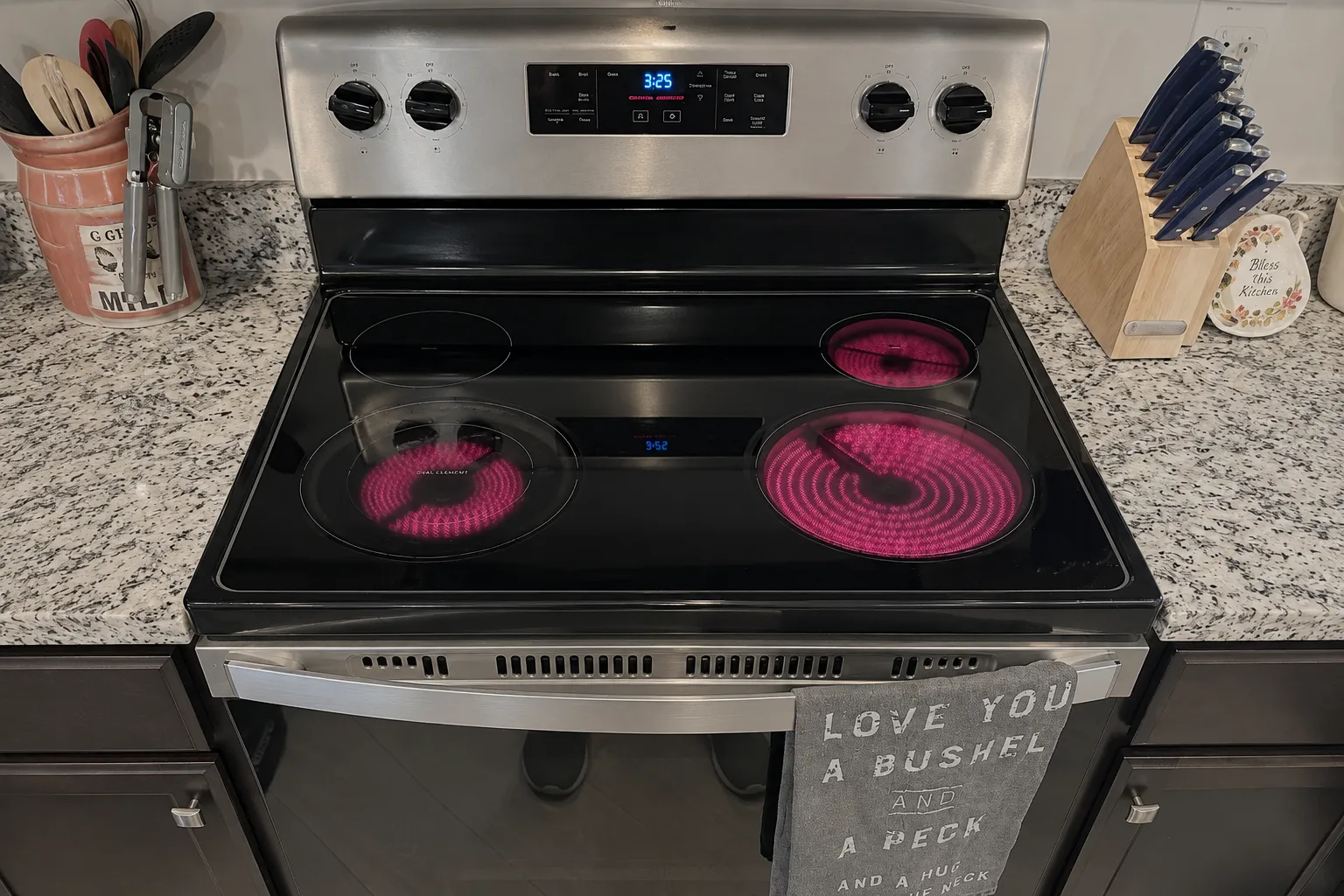
| Smooth-top element not heating | A failed radiant element, a failed infinite switch, or a limit thermostat that trips early | Tests the element, the switch, and the thermostat, then replaces the part that failed |
| Gas burner will not light | Clogged burner ports, a wet or misplaced burner cap, a worn igniter, or a failed spark module | Cleans the burner, checks the cap, and tests the igniter and the spark module |
| Constant clicking | A wet or dirty igniter, a burner cap that is not seated, or a stuck spark switch | Dries and cleans the igniter, reseats the cap, and tests the switch |
| Yellow or weak flame | Clogged burner ports, a cap that is not seated, a regulator problem, or a burner set up for the wrong gas | Cleans the ports, checks the flame with the cap seated, tests the regulator, and checks that the burner matches your gas type |
| Burner stays on high | A failed infinite switch on an electric range, or a worn gas valve or knob on a gas range | Tests the switch or the valve and replaces the part that fails |
| Door will not close, or sags | A worn hinge or hinge spring, or a damaged gasket | Replaces the hinge, the spring, or the gasket |
| Door stays locked after a self-clean cycle | A stuck lock motor or lock switch, or a control board fault | Tests the lock motor and the switch, then the board |
| Self-clean will not run, or stops | A blown thermal fuse, a failed lock, or a control fault | Tests the fuse and the lock and replaces the failed part |
| Display blank, error code, or clock resetting | A failed control board, a bad relay board, or a loose wiring connection | Reads the code, checks the connections, and tests the board |
| Buttons or touch panel not responding | A failed membrane switch or touch panel, or moisture behind it | Tests the panel and replaces it when it is the cause |
| Oven light out | A burned-out bulb, a failed socket, or a wiring fault | Replaces the bulb, the socket, or the wiring |
| Knobs loose, cracked, or spinning freely | A worn knob stem or a cracked knob | Replaces the knob and checks the switch behind it |
Gas ovens and electric ovens fail in different places, and a self-clean cycle is a common trigger. It runs the oven far hotter than normal cooking does, which is when a weak fuse, lock, or board gives up. If a problem shows up right after a cleaning cycle, say so when you book.
An electric oven that keeps heating with the controls off, or an electric burner that stays on high, should be switched off at the range's breaker. On a gas range, a burner or oven flame that will not go out with the control off points to a faulty valve. Close the range's gas shutoff valve if you can reach it without moving the range. If the flame will not stop, or you smell gas, leave the house and call 911 and your gas utility (or propane supplier) from outside.
A natural gas flame should be blue, with no yellow tips, though propane may show short ones. A few orange flecks that burn off are usually dust. A long, bright yellow or orange flame is not normal. It points to poor combustion and can produce carbon monoxide, so stop using that burner until it has been checked. Keep a working carbon monoxide alarm on every level of the home and outside sleeping areas, placed as the alarm's instructions say.
Which oven and range types do we service?
We service gas, electric, and dual-fuel ovens and ranges. The heating parts differ by fuel, and a wall oven is reached differently from a freestanding range, so tell us which you have when you book.
- Freestanding and slide-in ranges, gas, electric, and dual fuel
- Wall ovens, single and double, including built-in units
- Convection and air-fry models
- Professional-style ranges from brands such as Viking, Wolf, Thermador, and JennAir
A separate cooktop is covered under cooktop repair, and a hood over the stove under range hood repair. We work on GE, Whirlpool, Samsung, LG, Frigidaire, KitchenAid, and other major brands.
How does an oven or range repair visit work?
Book an arrival window online or by phone. At your home, the technician tests the oven or the range, finds the failed part, and gives you a written estimate for the repair. Nothing is repaired until you say yes.
The technician starts with the symptom. For an oven that is not heating, they check that it gets power, then test the bake element or the igniter, the temperature sensor, and the control. For a gas burner, they look at the burner, the cap, and the igniter before they test the spark module.
If the part is on hand, the repair is usually finished the same visit. If it has to be ordered, you choose when we come back. Parts for professional-style ranges can be special order, and the technician tells you the expected wait before you approve.
Before the visit, let the oven cool, take out pans and loose racks, and keep children and pets out of the kitchen. Have the model number ready. On a range it is usually on the oven frame, which you can see with the door open, or in the storage drawer opening. Do not pull a range away from the wall to look for it, because that can damage the gas connector and the anti-tip bracket that keeps the range from tipping over; if you cannot find it, the technician will.
Should I repair or replace my oven or range?
A repair makes sense when it costs well under half the price of a comparable new oven or range and the unit is sound otherwise. If a repair would cost about half of a new one or more, we tell you so and talk through the choice.
The National Association of Home Builders' 2007 life-expectancy study, an older but widely cited source, puts the typical life of a gas range at about 15 years and of an electric range at about 13. A repair is a good bet when:
- the range or oven is under about 10 years old
- the problem is an element, an igniter, a sensor, a switch, or a lock
- the oven cavity, the door, and the cooktop are in good condition
Replacement is often the better call when the cavity is rusted through, when the control board and the relay board are both failing on an older unit, or when the cooktop glass is cracked on an inexpensive range. Wall ovens are the exception, because a new one has to fit the cutout in your cabinets, so a repair deserves a closer look.
What can I check before I book an oven or range repair?
Quick checks
These checks take a few minutes and need no special tools.
- Look at the display and the settings. A control lock, a delay-start timer, or a demo mode can keep an oven cold while the clock works.
- Check the breaker. To reset it, switch it fully off, then on once, and if it trips again, stop and call us. On an electric range, if the display and the light work but nothing heats, one leg of the 240-volt supply may be dead because of a worn breaker or a loose connection. Do not open the back panel to look, since that is a job for a technician. If the plug, cord, or outlet is discolored, hot, or smells burnt, switch the range off at the breaker and call us. On a gas range, check that your other gas appliances work.
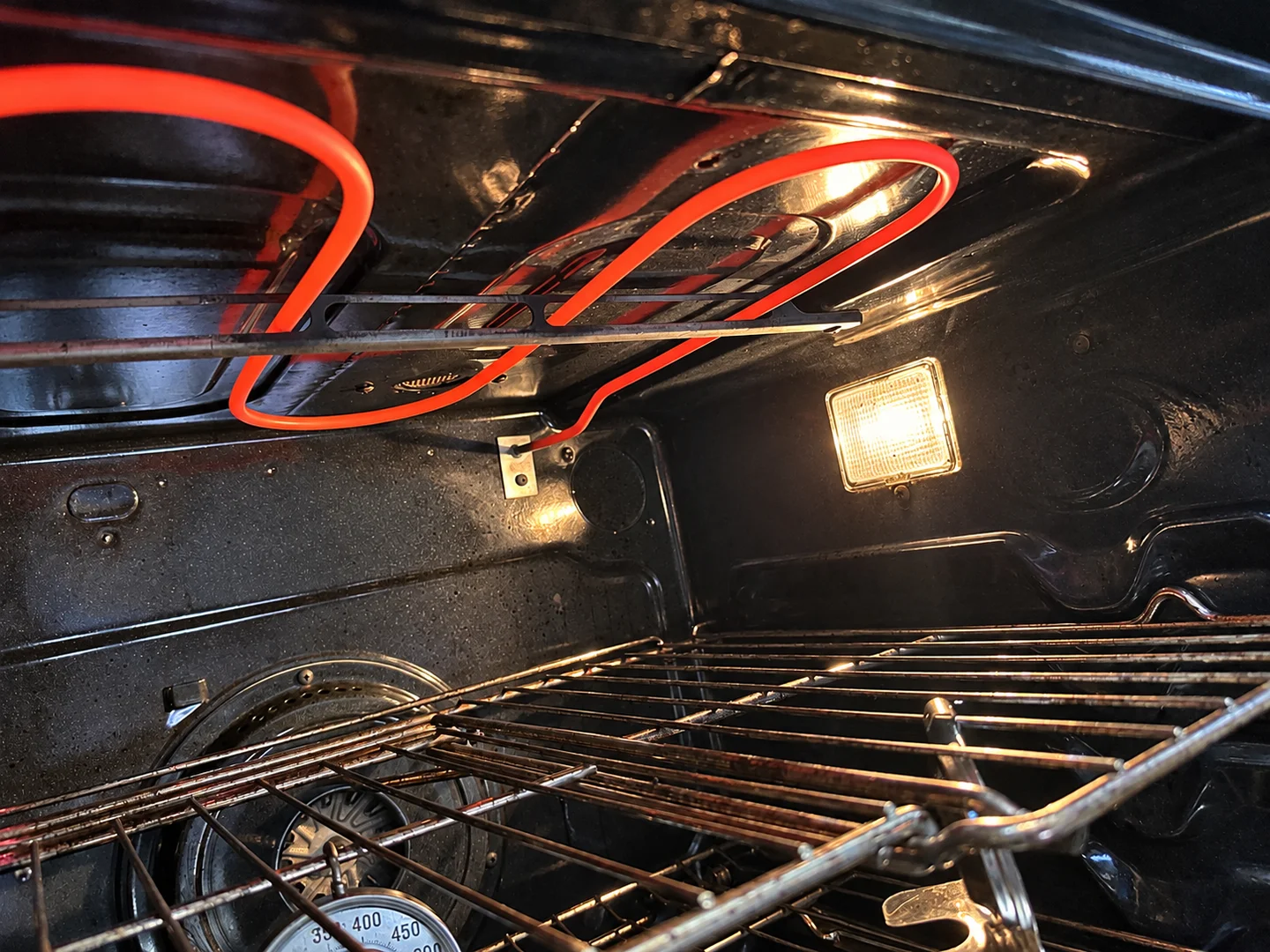
- On an electric oven, switch it off at the breaker and let it cool, then look at the bake element on the oven floor and the broil element at the top, if they are exposed. A blistered, cracked, or broken element needs replacing.
- For a gas burner that is off and cool, lift the cap and look for clogged ports. Brush them clean, and clear a stubborn port with a straight pin or needle held straight, without widening the hole. Do not use a wooden toothpick, because the tip can break off in the port. Let everything dry fully, and set the cap down level.
- Look at the oven door gasket without rubbing it. A gasket that is frayed or has gaps along the sides or the top lets heat out and changes the temperature. Many ovens have no gasket across the bottom of the door, so check the manual before you worry about a gap there.
- Compare the oven with a thermometer. Put an oven thermometer on the middle rack, set the oven to 350°F, and wait for the preheat signal plus another 10 minutes. Read it two or three times over a heating cycle and average the readings. If the average is off by 15 degrees or more, look in the manual for a temperature offset setting. Many ovens can correct about 35 degrees either way. Tell us when you book if that does not fix it.
If you smell gas, leave the house at once with everyone. From outside, call 911 and your gas utility, or your propane supplier if you have a tank. Do not light a match, flip a switch, or unplug anything.
Keeping an oven and range in shape
Wipe spills off the cooktop and the burner caps once they cool, because baked-on food clogs gas ports and shorts out coil receptacles. On a glass top, scrape up sugary spills and melted plastic while the surface is still warm, with the elements off, an oven mitt on, and a single-edge scraper, because cooled sugar can pit the glass. Before a self-clean cycle, take out the racks, pans, and foil, ventilate the kitchen, and keep children and pets out of it; pet birds can be killed by the fumes, so move them to a room far from the kitchen, with the door closed and a window open. Use the cycle sparingly, since the high heat is hard on the lock, the thermal fuse, and the control board. Do not scrub the door gasket, keep spills off it, and do not slam the oven door.
What does oven and range repair cost?
A diagnostic fee comes first, charged per oven or range, and then the price of the repair you approve. Your service area sets the fee, which can differ for built-in wall ovens, and it is waived when you go ahead with the repair. Pick your area in the list of service areas above to see its fee and typical labor prices.
What you pay for the repair is parts plus labor, and the part and your model decide the amount. Knobs, gaskets, and sensors sit at the low end. Control boards, gas valves, and convection fan motors cost more in parts and labor. You see the number in writing, on site, before work starts.
Labor is covered for 90 days on every repair. If the work fails in that time, we redo it with no labor charge. Parts are covered on separate terms, which depend on the part.