


What refrigerator problems do we repair?
We repair cooling and freezing problems, frost and defrost faults, ice makers and water dispensers, leaks, noises, control boards, and worn door seals on refrigerators and freezers.
| Symptom | Likely cause | What the technician does |
|---|---|---|
| Fridge and freezer both warm | Dirty condenser coils, a failed condenser or evaporator fan, an evaporator iced over by a defrost fault, a failed start relay or overload protector, an inverter or main board that has failed on a variable-speed model, or a compressor or sealed-system problem | Cleans and tests the coils and both fans, looks for frost on the evaporator, reads any error code, tests the relay and the overload protector or the inverter board, and only then tests whether the compressor and the sealed system work |
| Freezer cold, fridge warm | A failed evaporator fan motor, a stuck air damper, an iced-over evaporator, or, on a model with a separate cooling system for each section, a fault in the fridge section's own system | Checks airflow, tests the fan and the damper, and looks for frost on the evaporator |
| Food freezing in the fridge | A damper stuck open, a bad temperature sensor, or a control board that misreads the temperature | Tests the damper and the sensor readings, then replaces the part that is off |
| Runs all the time or cycles too often | Dirty coils, a weak door seal, a failing fan, a hot room, heavy door use, or a weak sealed system | Checks the coils, the seals, and the fans, and compares the temperatures with the set point |
| Frost on the freezer back wall | A failed defrost heater, defrost thermostat, or defrost control, or a gasket that lets in warm, humid air | Tests each defrost part, replaces the failed one, and checks the door seal |
| Water pooling inside the fridge | A frozen or clogged defrost drain | Clears the drain, checks the heater that keeps it thawed, and tests drainage |
| Ice maker not making ice | A failed water inlet valve, a frozen fill tube, a bad ice maker module, or a clogged filter | Checks water flow, thaws the fill tube, tests the valve and the ice maker, and replaces the failed part |
| Water dispenser slow or not working | A clogged water filter, a failing inlet valve, or a frozen line | Replaces the filter if needed, tests the valve, and checks the line for ice or kinks |
| Water on the floor | A loose or cracked water line, a failing inlet valve, or a leaking ice maker or filter housing | Traces the water to its source, then repairs or replaces the leaking part |
| Loud buzzing, humming, or rattling | A worn fan motor, a fan blade rubbing on ice, or a loose compressor mount | Finds which fan or part makes the noise, then replaces the motor or fixes the mount |
| Repeated clicking from the back | A failing start relay or overload protector, so the compressor tries to start and stops | Tests the relay and the overload protector and checks whether the compressor starts |
| Display or buttons not responding | A failed control board or display board | Checks power to the board, tests it, and replaces it when it is the cause |
| Will not turn on at all | No power at the outlet or the cord, a tripped breaker or GFCI, or a failed main board | Tests the outlet and the cord, then tests the main board |
| Interior light out, cooling normal | A burned-out bulb or LED module, or a bad door switch | Replaces the bulb or the module and tests the door switch |
| Door will not seal, or sweats | A torn or hardened gasket, worn hinges, or a door that has dropped out of alignment | Tests the seal, replaces the gasket, and adjusts or replaces the hinges |
| Broken shelves, bins, or drawers | Cracked plastic, worn slides, or a broken door bin | Orders and fits the matching part for your model |
A warm fridge can come from a dirty coil or from a failed board, and the two repairs cost very differently, so the technician tests before anything is ordered. Variable-speed models run for long stretches at low speed, which is normal as long as the temperatures hold. Sealed-system work (the compressor, evaporator, condenser, and refrigerant lines) is the most involved repair a refrigerator can need. On an older unit it is the one most worth weighing against the price of a new refrigerator.
Which refrigerator types do we service?
We service most home refrigerators and freezers, from basic top-freezer models to built-in columns. A French-door model or a built-in column needs different parts and more access work than a top-freezer, so tell us the style when you book.
- Top-freezer and bottom-freezer models
- Side-by-side models, with or without water and ice in the door
- French door models, including four-door designs
- Built-in and column refrigerators and freezers from brands such as Sub-Zero, Thermador, and JennAir, many with a separate cooling system for each section
- Beverage and wine coolers
- Standalone and undercounter ice makers
Models with water and ice in the door add a water line, a filter, and an inlet valve to the list of things that can leak or freeze, which is why leaks and ice maker faults are so common on them. We work on Whirlpool, GE, Samsung, LG, Frigidaire, Maytag, KitchenAid, and other major brands.
How does a refrigerator repair visit work?
You book an arrival window online or by phone, and a technician comes to your home. They check the refrigerator, find the failed part, and give you a written estimate for the repair. Nothing is repaired until you approve it.
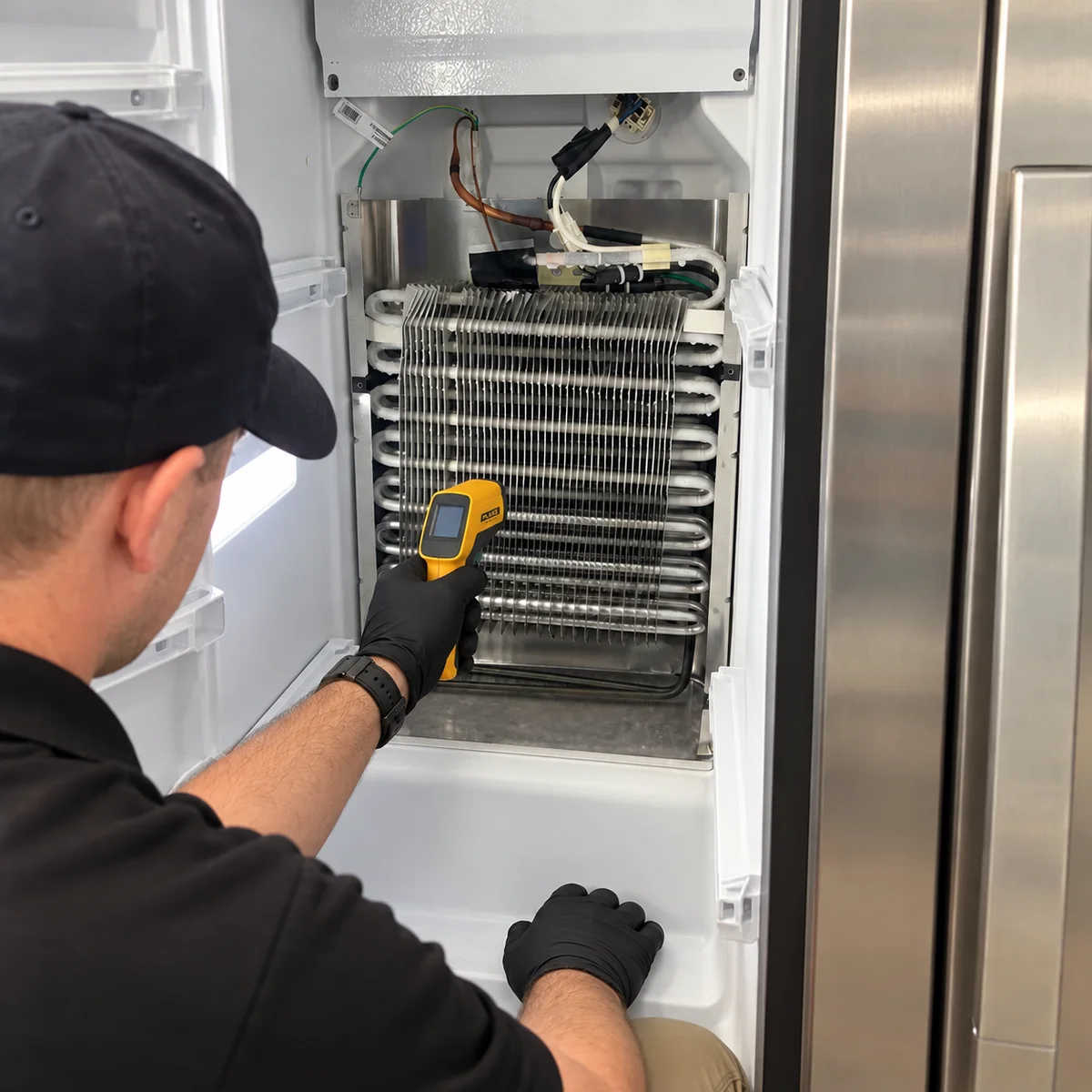
What the technician checks depends on the symptom. For a warm fridge, they measure the temperature in both sections, look at the condenser and evaporator fans, check for frost, and test the defrost parts and the start relay before they look at the sealed system. For a leak, they follow the water back to where it starts before they touch anything.
If the part is with the technician, the repair is usually finished the same visit. If it has to be ordered, you pick a time for us to come back.
Before the visit, clear the space in front of the refrigerator and move food from a warm fridge into a cooler. Have the model number ready. On most refrigerators it is on a sticker inside the fresh-food section, often on a side wall, and it helps the technician bring the right parts.
Should I repair or replace my refrigerator?
Repair it when the fix costs well under half the price of a comparable new refrigerator and the unit is in good shape otherwise. If a repair would cost more than about half of a new one, we tell you so and talk through whether it makes sense.
The National Association of Home Builders' 2007 life-expectancy study, an older but widely cited source, puts the typical life of a refrigerator at about 13 years and of a freezer at about 11. Many last longer when the coils stay clean and the door seals stay tight. As a rule of thumb, a repair is worth it when:
- the refrigerator is under about 10 years old
- the problem is a single part, such as a fan motor, a defrost heater, a water valve, or a control board
- the cabinet and the door seals are in good condition
Replacement is often the better call when the sealed system has failed on an older unit, when several parts are failing at once, or when the cabinet is rusted through. Built-in and column units are the exception. They cost far more to replace and need cabinet work, so a repair deserves a closer look even at an older age.
What can I check before I book a refrigerator repair?
These checks take about ten minutes and sometimes solve the problem.
- Make sure the refrigerator has power. Plug a lamp into the same outlet, and check the breaker and the plug.
- Look at the temperature setting and the display. On some models a showroom or demo mode turns the cooling off while the lights and display stay on, and the owner's manual shows how to switch it back.
- Put an appliance thermometer in the fresh-food section and in the freezer, and read it after several hours with the doors closed. The FDA recommends 40°F or below for the refrigerator and 0°F for the freezer.
- Test the door seal. Close a dollar bill in the door, and if it slides out without any drag, the gasket is not sealing at that spot.
- If the condenser coils behind the bottom grille are covered in dust or pet hair, unplug the refrigerator, snap off the grille, and vacuum the coils with a brush attachment. Leave any screwed panel on the back alone, because the compressor compartment is behind it.
- Make sure food is not blocking the vents inside. Cold air needs a clear path from the freezer to the fridge.
- Write down the model number and any code on the display. Many newer refrigerators with variable-speed compressors store an error code that points the technician to the fault.
If the freezer wall is covered in frost, you can run a full defrost. Move the frozen food to a second freezer or a well-iced cooler (a cooler will not keep it frozen for a full day, so refresh the ice), unplug the unit, put towels on the floor, and leave the doors open until the ice has melted. Never chip the ice with a knife, an ice pick, or a scraper, and do not use a heat gun or a steamer to speed it up. Many newer refrigerators hold a small charge of flammable refrigerant, so a punctured evaporator is a fire risk as well as a costly repair. If that happens, keep the refrigerator unplugged, keep flames and sparks away, do not use fans or light switches, open the windows, and keep people and pets out of the room while it airs out for several minutes. The gas has no added odor, so do not use smell as the all-clear. Then call us. If the frost comes back within days or weeks, the defrost system or a leaking door seal is the likely cause, and a technician should test both.
If you see smoke or flames, leave the house and call 911. If you smell burning or see sparks, switch off the refrigerator's breaker if you can reach the panel safely, and call us. If water has pooled near the plug or the outlet, stay out of it and switch off that circuit's breaker from a dry spot before you call.
What does refrigerator repair cost?
You pay a diagnostic fee per refrigerator, then the price of the repair you approve. Your service area sets the fee, and it is waived when you go ahead with the repair. Pick your area in the list of service areas above, and its page shows the fee and typical labor prices for common refrigerator repairs.
The repair price is parts plus labor, and it depends on the part and on your model. A door gasket or a water valve costs far less than a control board, and a compressor costs more than either. The written estimate gives the total, so you can weigh it against a comparable new refrigerator before you say yes.
Labor on every repair is covered for 90 days. If the work we did fails in that time, we come back and redo it with no labor charge. Parts carry their own coverage, which depends on the part and on who supplied it.