



Most BlueStar gas ranges are mechanical: gas valves, spark igniters, a spark module and a knob-set oven thermostat, with no main circuit board. On open-burner models the star-shaped burner heads sit in plain view under the grates, and spills fall through to the drip tray instead of pooling around a sealed base, but grease and moisture still reach the igniters.
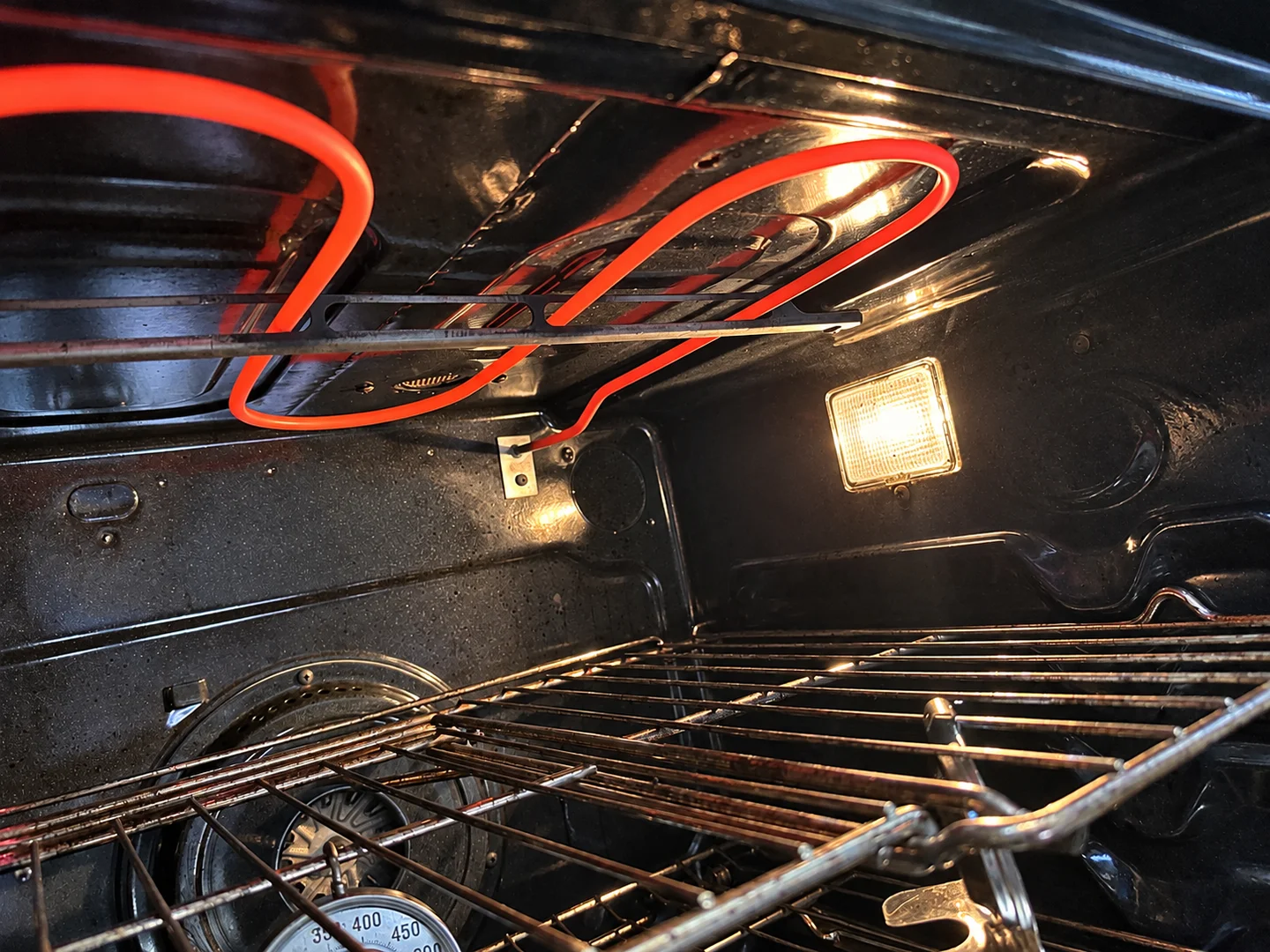
The BlueStar oven pairs a bake burner with a ceramic infrared broiler, each with its own igniter. Because the gas models have no display, there are no codes to read; we test igniter current, valve operation and thermostat accuracy instead.
What breaks in BlueStar ranges and ovens
- Oven ignition. The BlueStar bake burner lights from its own igniter, switched through the oven thermostat valve; as the igniter weakens, the oven lights late or stays cold.
- Infrared broiler. The ceramic broiler has a separate igniter, and its tiles can crack from thermal shock; either one leaves a cold or patchy broiler.
- Thermostat drift. The mechanical thermostat can read off or stop cycling; we test, calibrate or replace it.
- Convection fan and door. Fan motors get noisy, and the heavy BlueStar door wears its hinge springs and gasket.
How an oven or range repair visit goes
What breaks in BlueStar rangetops and cooktops
- Clicking or no spark. Every BlueStar burner igniter runs off one spark module; a cracked igniter, wet spark switch or failing module means nonstop clicking or a dead burner.
- Open versus sealed burners. On open-burner models we lift the star burner head and clear the ports and venturi; on sealed-burner models the igniter sits under the cap, and cap alignment matters.
- Valves, griddles and charbroilers. Stiff knobs mean a valve needs service, and grease-clogged griddle or charbroiler burners light unevenly.
- Induction models. Power boards and cooling fans fail, and a blocked air intake under the counter trips the overheat protection.
How a cooktop repair visit goes
What breaks in BlueStar range hoods
- Blower wear. BlueStar hoods are sized for high-output open burners and run hard; internal, in-line and remote blower motors lose bearings and capacitors.
- Controls. Switches and speed controls sit directly above those burners and take the heat and grease first.
- Lights. Sockets and lamps fail from constant heat cycling over a BlueStar range.
- Baffle filters. Grease-loaded baffles choke airflow and make the blower louder, so we clean them and check draw before replacing any motor.
How a range hood repair visit goes
What breaks in BlueStar refrigerators
- Condenser airflow. BlueStar built-in refrigerators sit flush in cabinetry, so a blocked grille or dusty condenser warms both sides quickly.
- Fans and defrost. A slow evaporator fan or failed defrost heater frosts the coil and warms the fresh food side.
- Ice maker and water valve. Low water pressure or a failed valve leaves the bin empty.
- Sealed system. We diagnose compressor and leak failures and do the sealed-system work in your kitchen.
- Heavy doors. Hinges and closers on panel-ready and color-matched BlueStar doors carry real weight; we adjust or replace them in place.
How a refrigerator repair visit goes
Parts and warranty on BlueStar repairs
We install OEM BlueStar parts only. Range parts such as igniters, spark modules, valves, thermostats and broiler components carry across many years of BlueStar production, so older ranges are usually serviceable. Color-matched panels, doors and trim are made to order in your color and take longer, as do some refrigeration parts. If your BlueStar is still under the manufacturer's warranty, contact BlueStar first; we do not perform warranty repairs. Our repairs carry a 90-day labor warranty.