


What dishwasher problems do we repair?
We repair draining and filling faults, poor cleaning and drying, leaks, noise, door and latch faults, and control faults on built-in and drawer dishwashers.
| Symptom | Likely cause | What the technician does |
|---|---|---|
| Water stays in the bottom | A clogged filter or drain hose, a failed drain pump, or a drain that backs up from the sink or the disposal | Cleans the filter, clears the hose, checks the connection at the sink, and tests the drain pump |
| Will not fill, or fills slowly | A failing water inlet valve, a stuck float switch, a clogged inlet screen, or a closed supply valve | Checks the supply valve, cleans the screen, and tests the inlet valve and the float switch |
| Leaks from the door or underneath | A worn door gasket, a cracked hose, a leaking pump seal, a failing inlet valve, or a cracked tub | Runs a cycle to find where the water appears, then replaces the failing part |
| Overfills | A stuck inlet valve or a failed float switch | Tests the valve and the switch and replaces the one that is off |
| Dishes come out dirty or gritty | Clogged spray arms or filter, a weak wash pump, a detergent dispenser that does not open, or water that is not hot enough | Checks the spray arms and the filter, tests the dispenser and the pump, and checks the water temperature |
| Detergent left in the cup | A tall dish blocking the dispenser door, clumped detergent, a latch that does not release, or a spray arm that cannot reach the door | Checks the loading, tests the dispenser, and replaces the latch or the whole dispenser |
| Dishes still wet at the end | A failed heating element, a bad thermostat or temperature sensor, or an empty rinse aid dispenser | Tests the heating circuit and the element and checks the rinse aid dispenser |
| Will not start | A failed door latch or switch, a blown thermal fuse, a failed control board, or a tripped breaker | Checks power, then tests the latch, the fuse, and the board |
| Stops mid-cycle, or lights blink | A failed circulation pump, a sensor fault, or a control board fault | Reads the code, then tests the part it names |
| Buttons do not respond | A failed touchpad or control board | Tests the panel and the board and replaces the failed one |
| Grinding or humming | A jammed or worn pump, debris in the pump, or a worn motor bearing | Clears the pump, then tests the motor and the bearing |
| Rattling or banging | A spray arm hitting a rack, a loose part, or a worn rack roller | Realigns the arm and replaces the loose or worn part |
| Door will not close or latch | A broken latch, worn door springs or cables, or a bent door strike | Replaces the latch, the springs, or the cables |
| Racks stick, or the wheels are broken | Worn rack rollers or broken adjusters | Replaces the rollers and the adjusters |
Many dishwashers drain through the sink or the garbage disposal, so a dishwasher that will not drain is sometimes a sink problem. A new garbage disposal has a small knockout plug in the port where the dishwasher hose connects, and a plug left in place blocks the drain completely. The drain hose should also rise in a high loop under the counter, or run through an air gap beside the faucet, so that sink water cannot flow back into the tub. The technician checks the whole drain path before replacing a pump.
Which dishwasher types do we service?
We service the dishwashers found in most kitchens, from standard built-in models to drawers. A drawer unit and a panel-ready model are reached differently, so tell us which one you have when you book.
- Built-in dishwashers, 24 inches wide, with a stainless, black, or white front
- Panel-ready models that hide behind a cabinet panel
- Drawer-style dishwashers, single or double, such as those from Fisher & Paykel
- Compact 18-inch models
We work on Bosch, KitchenAid, GE, Whirlpool, Samsung, LG, Miele, and other major brands.
How does a dishwasher repair visit work?
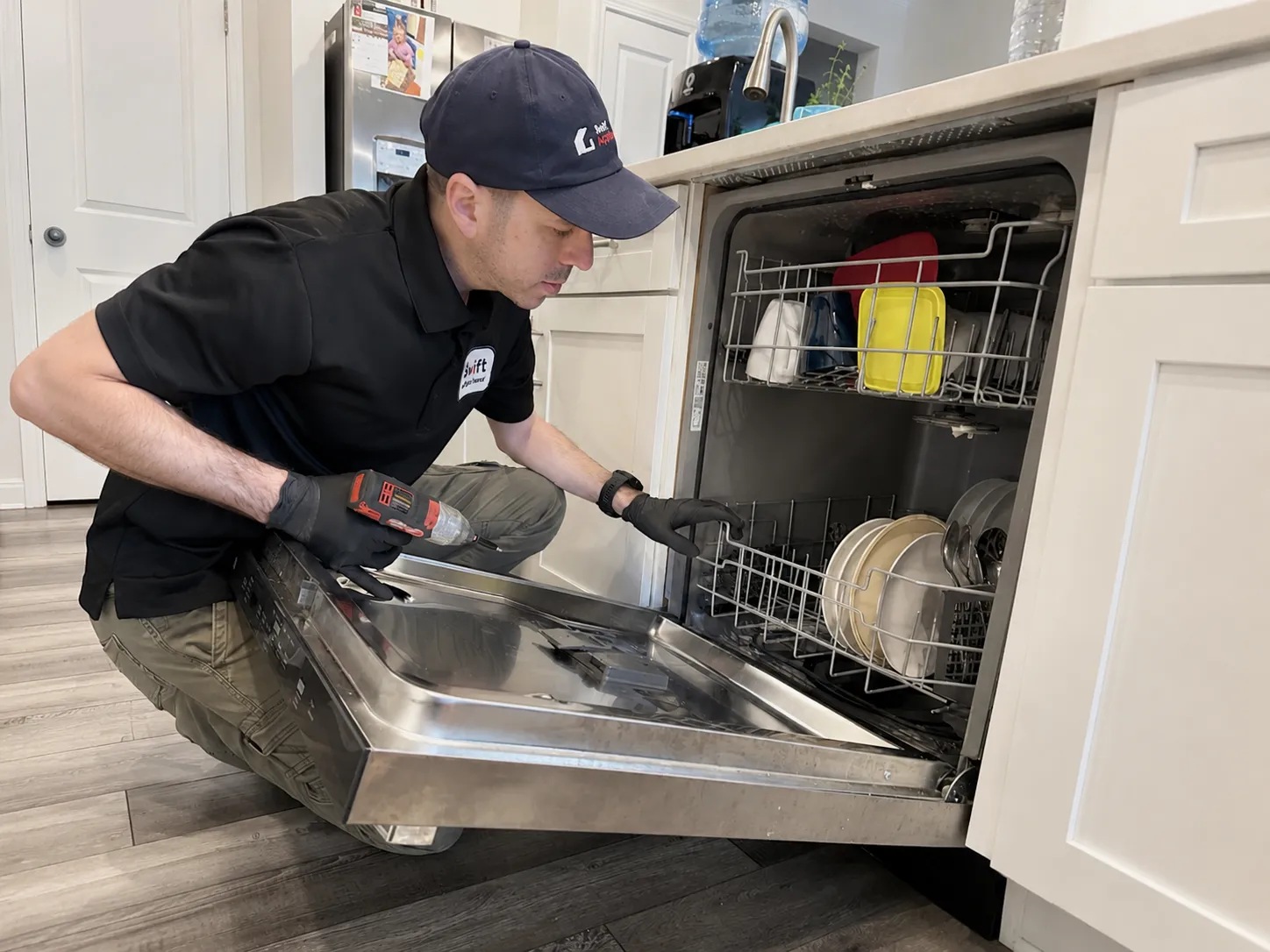
Pick an arrival window online or by phone, and a technician comes to your home. The dishwasher is tested, the failed part is identified, and you get a written estimate for the repair. You approve it before anything is repaired.
On site, the technician runs a cycle and watches what the machine does: whether it fills, how it circulates, whether it drains, and whether it heats. Then they check the filter and the spray arms, the drain connection under the sink, and the parts that match what they saw. Each of those four stages points to a different set of parts, so a test cycle narrows the search fast.
Most repairs finish the same visit when the technician has the part. If it has to be ordered, you pick a time for us to come back.
Before the visit, empty the dishwasher, because a full rack hides leaks and gets in the way. Clear the cabinet under the sink if you can, since the hoses and the valves are there. Have the model number ready. It is on a label on the edge or the inside of the door, or on the side of the tub.
Should I repair or replace my dishwasher?
Repair it when the fix costs well under half the price of a comparable new dishwasher and the tub and door are in good shape. A new dishwasher usually costs less than a refrigerator or a range, so the half-price line is reached sooner here. When a repair passes about half the price of a new one, we say so and talk it through.
The National Association of Home Builders' 2007 life-expectancy study, an older but widely cited source, puts the typical life of a dishwasher at about 9 years. Repair is the sensible choice when:
- the dishwasher is under about 6 or 7 years old
- the problem is a drain pump, a valve, a latch, a float switch, or a heating element
- the tub is clean of rust and the door seals well
Replacement is often the better call when the tub is rusted or cracked, when the wash pump or motor and the control board are both failing on a machine near 10 years old, or when the repair is priced close to half of a new unit.
What can I check before I book a dishwasher repair?
Quick checks
Start with the simple ones.
- Make sure the door closes and latches fully, and that the controls are not locked. Many panels lock when a key is held for a few seconds.
- Check the breaker panel, and press RESET on any GFCI outlet in the kitchen. If the GFCI or the breaker trips again, leave it off and call us. Do not open the dishwasher's electrical box or test its wiring: many dishwashers are hardwired and have no plug to check.
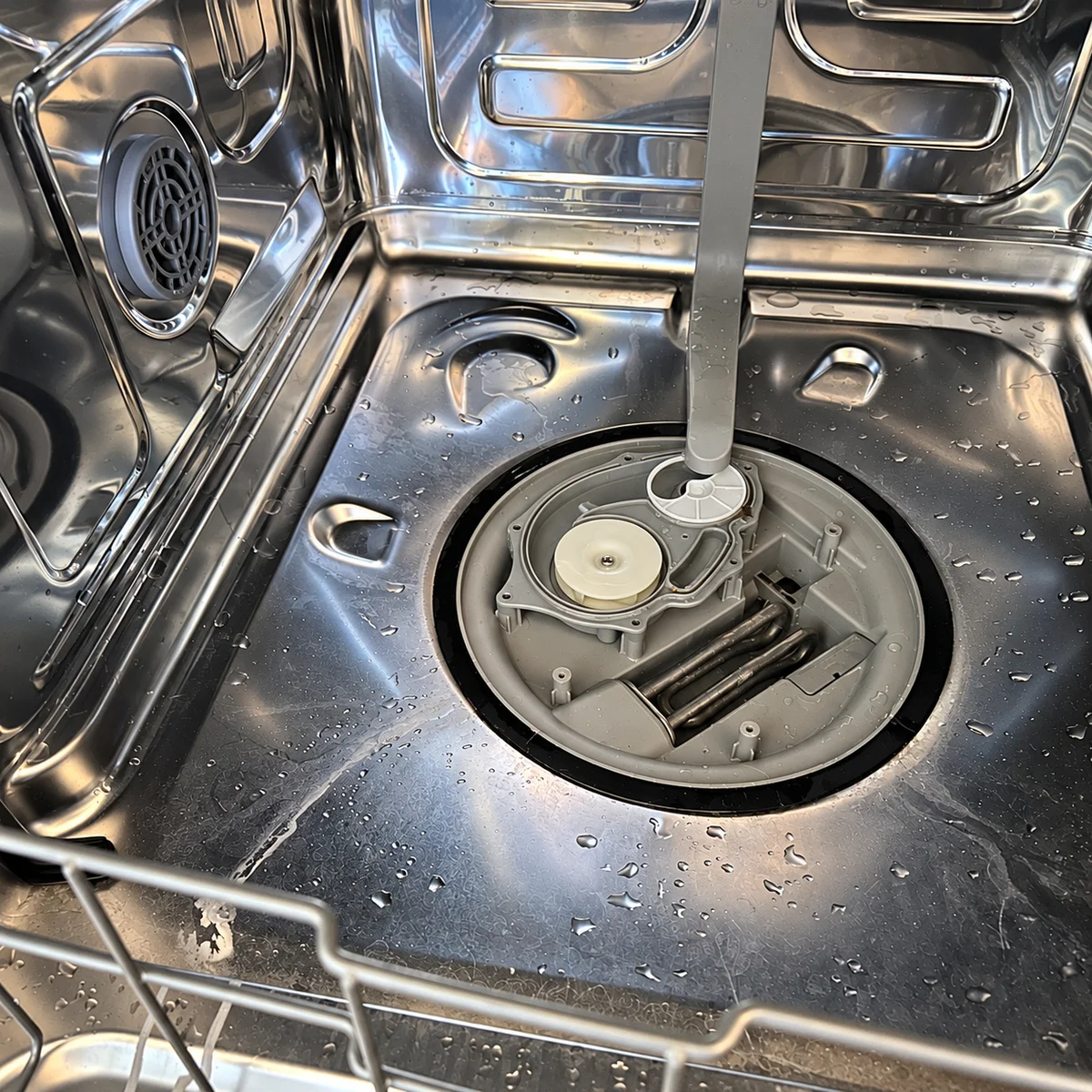
- For standing water, switch the dishwasher's breaker off, or unplug it, and let the tub and the water cool, because the heating element can stay hot after a cycle. Take out the lower rack and clean the filter at the bottom. Wear thick gloves, and look for food, broken glass, and bits of label.
- If the dishwasher drains through a disposal, switch the disposal off at its breaker before you look into it, and never put a hand inside. On a new disposal, the knockout plug in the dishwasher port may still be in place, and a technician can remove it. Otherwise, switch the breaker back on, run the disposal with water to clear it, then run a drain cycle.
- Spin the spray arms by hand. They should turn freely, and the holes should be clear. A toothpick works for a clogged hole.
- Use only dishwasher detergent. Dish soap makes suds that overflow and cause leaks.
- Run the hot tap at the sink until the water is hot, then start the cycle. Most manufacturers want water of about 120°F (49°C) entering the dishwasher, so a low water heater setting is a common reason for dirty dishes.
If water is leaking, do not run the dishwasher again. If the water is near an outlet, switch off the breaker from a dry spot first. Then close the water shutoff valve, usually under the sink.
Small habits that protect a dishwasher
Scrape plates, and check your manual before rinsing them clean, because many sensors and detergents work best with a little soil. Clean the filter once a month. Do not overload the racks or block the spray arms with tall items. Once in a while, run an empty hot cycle with a dishwasher cleaner to clear grease and mineral buildup.
What do common dishwasher error codes mean?
Codes differ by brand and model, so check your manual first. These are Bosch's common drain, fill, and heating codes, as Bosch lists them on its support pages, with the first thing to try.
| Code | What it usually means | What to try first |
|---|---|---|
| E24 | The drain filter is blocked, so the dishwasher is not draining properly | Clean the filter, check the drain hose for kinks, and if it drains into a disposal, make sure the knockout plug is out |
| E25 | The drain pump is blocked, or its cover is loose or missing | Switch off the power, remove the filter, clear debris from the pump area with gloves on, and press the pump cover back into place |
| E22 | The filter is blocked | Take the filter out, rinse it, and scrub it gently with a soft brush |
| E17 | Water is not flowing in as it should | Check the inlet hose for kinks and make sure the supply valve is open |
| E15 | The safety switch found water in the base of the dishwasher | Shut off the water supply and switch off the power, then book a visit so the leak can be found |
| E09 | A heating fault | Switch off the breaker for 30 seconds, and book a visit if the code returns |
Other brands use their own codes, and the same code can mean different things on different brands. A code names the circuit where the fault was detected, which is not always the part that failed, so the technician tests before replacing anything.
What does dishwasher repair cost?
You pay a diagnostic fee for the dishwasher, then the price of the repair you approve. Your service area sets the fee, and it is waived when you go ahead with the repair. Pick your area in the list of service areas above to see its fee and the labor prices for common dishwasher repairs.
Parts plus labor make up the repair price, and it varies with the part and your model. Latches, gaskets, and float switches are quick, lower-cost jobs. Wash pumps, motors, and control boards cost more in parts and take longer. The written estimate comes on site, before any work starts.
We cover labor for 90 days on every repair. If the work we did fails in that time, we come back and redo it with no labor charge. Parts come with whatever coverage the part itself carries, which varies. If you have a home warranty plan, you pay at the visit and we give you an itemized invoice and a written diagnosis to submit to your provider.