


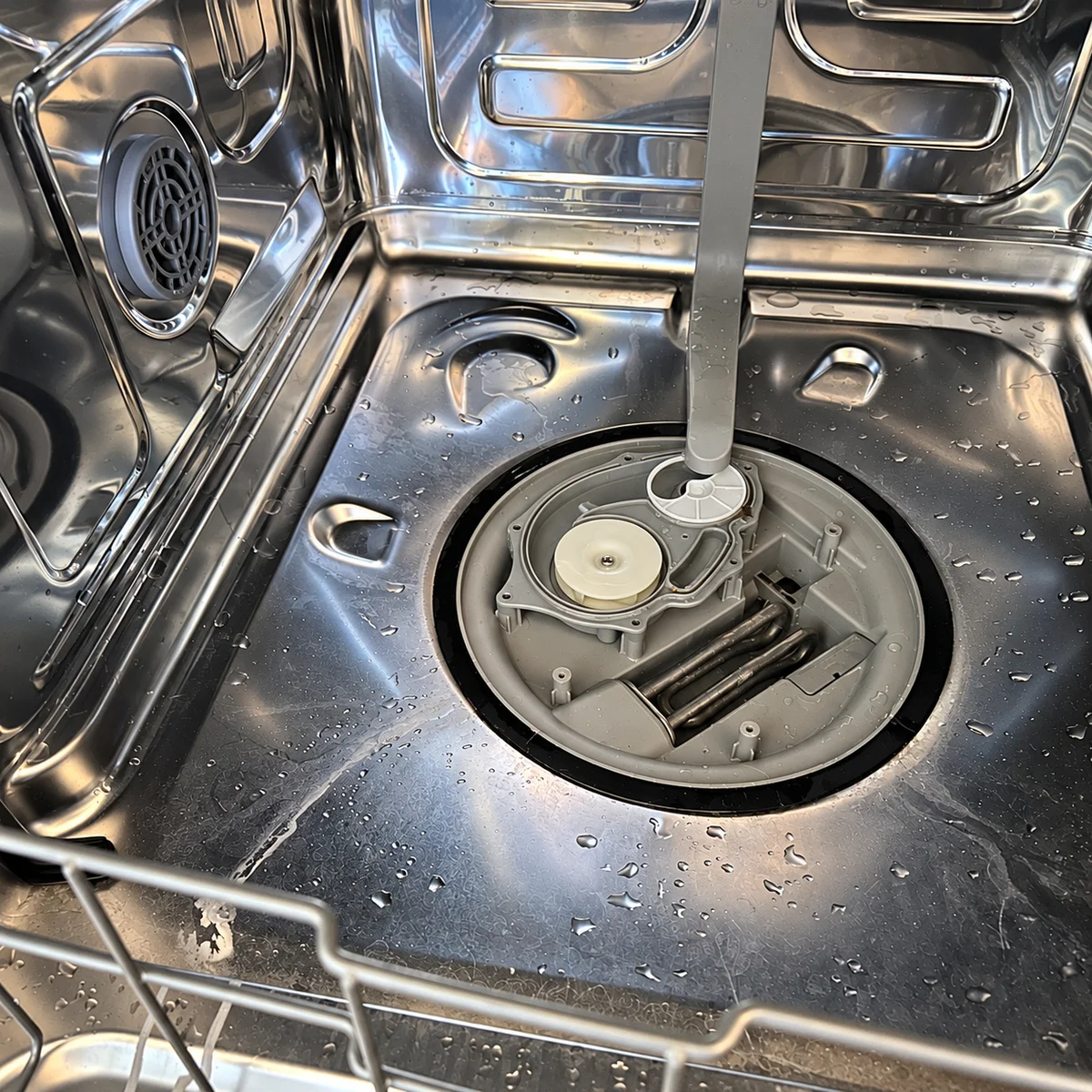

Fisher & Paykel designs differently from most brands. The DishDrawer splits a dishwasher into independent drawers, each with its own lid that lowers to seal the tub and a small motor and rotor that wash and drain. SmartDrive washers turn the basket directly from a brushless motor with no belt or gearbox. ActiveSmart refrigerators manage cooling and defrost electronically instead of on a fixed timer.
That makes diagnosis code-driven and component-based. Failures cluster around lid actuators, motor sensors, diverter valves, fans and control boards, and most are repaired without replacing the whole appliance.
What breaks in Fisher & Paykel DishDrawers
- Lid will not close or seal (F5). The lid actuator motor or its gears wear, or the lid jams, and the drawer cannot start. A hardened lid seal is usually replaced at the same time.
- Motor and rotor faults (F2). Food debris or glass jams the rotor, or the motor stator fails; the drawer hums and does nothing.
- Flood switch (F1). Water reached the base, often past a worn lid seal.
- Flex harness. The cable that follows the drawer in and out fatigues, causing intermittent faults in one drawer only.
How a dishwasher repair visit goes
What breaks in Fisher & Paykel washers
- SmartDrive motor faults. The direct-drive motor has a stator, a magnet rotor and a rotor position sensor. A failed sensor or stator winding causes stalls and motor fault numbers; the rotor rarely fails.
- Diverter valve. The pump sends water either to the drain or back into the tub through a diverter; when it sticks, the washer will not drain or recirculate.
- Basket will not engage for spin. Worn clutch splines or a sticking drive shaft.
- Motor control module failures stop the machine outright.
How a washer repair visit goes
What breaks in Fisher & Paykel dryers
- Vented dryer with no heat. On electric models the element or a thermal cutout opens; on gas models the igniter glows but weak valve coils never let the gas through. A tripped cutout sends us to the exhaust run first.
- Heat pump dryer drying slowly. Ventless heat pump models depend on clean airflow across the heat exchanger; lint that slips past the filter packs the fins and stretches cycles.
- Drum will not turn. A broken belt or a seized idler pulley.
- Cycles ending too early or late. Coated moisture sensor bars mislead the auto-dry cycle.
What breaks in Fisher & Paykel refrigerators
- French door fridge warming. On ActiveSmart models the evaporator or condenser fan fails, or the control board stops calling for cooling. Fans and board outputs are tested before the compressor is blamed.
- Freezer icing. Adaptive defrost still depends on a heater and sensors; when one fails, the evaporator ices over.
- Sealed-system repair. Leaks and failed compressors call for leak repair or compressor replacement, evacuation and recharge.
- Ice and water. Inlet valves and ice maker modules fail on plumbed models.
How a refrigerator repair visit goes
What breaks in Fisher & Paykel ovens and ranges
- Oven heats slowly or unevenly. Bake, broil and fan elements or the temperature sensor fail on wall ovens and ranges.
- Convection fan noisy or stopped. The rear fan motor bearing wears.
- Door stays locked after self-clean. The lock motor or its switch fails on pyrolytic models.
- Cooling fan failure overheats the controls and shuts the oven down.
- Dual fuel and gas ranges. Burner igniters, the spark module and the oven igniter fail, especially after spills reach the ignition switches.
How an oven or range repair visit goes
What breaks in Fisher & Paykel cooktops
- Induction zone dead or cutting out. A failed power board, an induction coil, or a weak cooling fan that lets the electronics overheat.
- Gas burners clicking or not lighting. Wet or shorted ignition switches, cracked electrodes, or a failing spark module; the caps must sit flat on the burner bases.
- Touch controls unresponsive. The control board under the glass fails or reads a spill as a key press.
- Electric radiant zones dead from an element that has burned open.
How a cooktop repair visit goes
What breaks in Fisher & Paykel range hoods
- Blower slow or loud. Grease on the fan wheel or a failing motor, both sped up by clogged filters.
- Control panel dead. The control board or switch pad fails after years of heat and steam.
- Lights out. LED modules and their drivers fail and are replaced as parts, not bulbs.
- Insert and island hoods. Motor access is tighter on these, but the failures are the same blower and board parts as on wall models.
How a range hood repair visit goes
Parts and warranty on Fisher & Paykel repairs
We install OEM Fisher & Paykel parts only. DishDrawer lid actuators, rotors, seals and SmartDrive motor parts are generally well supported, while some control boards and less common oven parts take longer to arrive. Boards must match the model and revision exactly, so the part is confirmed before ordering. If your Fisher & Paykel is under the manufacturer's warranty, call Fisher & Paykel first, because we do not perform warranty repairs. Each completed repair carries our 90-day labor warranty.
Fisher & Paykel codes we see most often
These are the display codes that bring us the most Fisher & Paykel calls. The wording is ours, and the meaning can shift between model years, so treat the table as a starting point: a technician confirms the cause with tests before any part is replaced.
| Code | What it usually points to |
|---|---|
| F1 | Flood switch tripped; water has reached the base of the drawer |
| F2 | Wash motor problem; rotor jammed or motor fault |
| F3 | Temperature sensor fault, or incoming water is too hot |
| F4 | Temperature sensor or heating element fault |
| F5 | Lid motor drawing too much current; lid jammed up or down |
| U1 | Fill fault; water supply off or spray arm not seated |