



Miele machines are engineered for a long service life, and the heavy hardware usually outlasts the electronics around it: drums, tubs and spray systems rarely wear out, while pumps, relays and sensors do. Faults are stored as F-codes, and the fault memory says far more than the symptom alone, so it is the first thing a technician reads on a Miele.
Parts are the main difference with this brand. Miele supplies most parts through its own channel, some electronic modules need configuration after fitting, and lead times can be longer than on mainstream brands, so plan for that when a board or pump is needed.
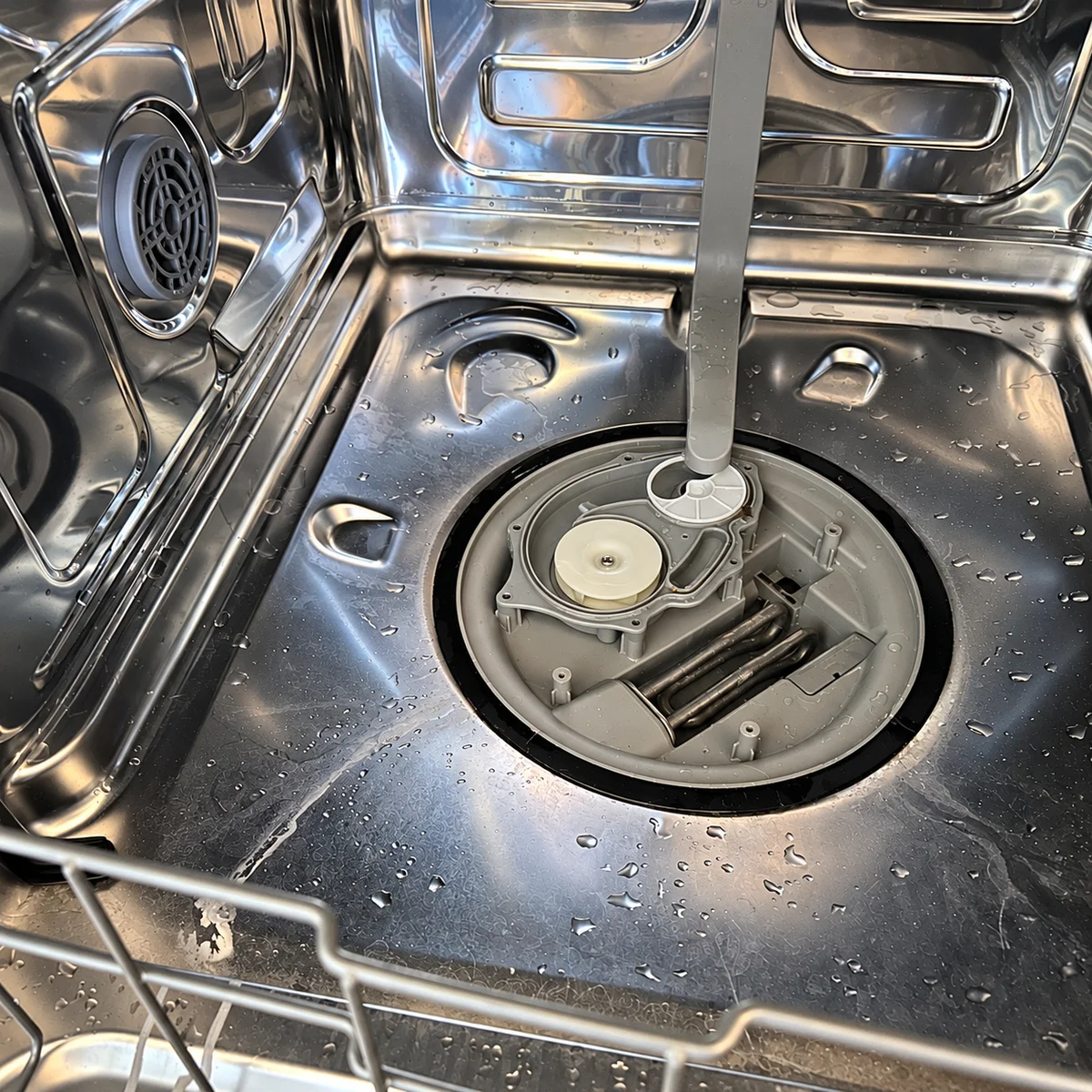
What breaks in Miele dishwashers
- Drain faults. Debris in the drain pump or a stuck non-return valve in the sump; a pump that hums without turning is replaced.
- Heater pressure switch fault (F14). The fill was metered in, but too little water reached the heater: clogged filters, heavy foam, water siphoning out through the drain hose, or a blocked pressure switch hose.
- Circulation pump (F78). The pump or its wiring between the door electronics and the tub fails, and dishes come out unwashed.
- Heater relay (F24). The relay on the control board fails, and the board is replaced.
- F70. Water in the base pan; the leak is found first.
How a dishwasher repair visit goes
What breaks in Miele washers
- Heating fault (F20). The element or the heater relay on the electronic module fails, and the program stops or runs long trying to reach temperature.
- Drain fault (F11). Coins, buttons and lint collect in the drain pump behind the lower front flap; a broken impeller means a new pump.
- Intake fault (F10). Clogged inlet screens or a failed valve.
- TwinDos not dosing. Dried detergent blocks the dosing pumps or lines.
- Drum noise. The honeycomb drum itself rarely fails. A rumble that grows in spin means worn drum bearings, a major job weighed against the machine's age; a scraping sound usually means an object trapped between drum and tub.
How a washer repair visit goes
What breaks in Miele dryers
- T1 heat-pump dryer runs long. Lint passes the door filters and packs the plinth filter and heat exchanger fins, cycles stretch, and the Clean airways message appears. We clean the exchanger and check airflow.
- Condensate faults. When the condensate pump or a plumbed drain line clogs, the dryer stops and asks for the container to be emptied or the drain checked.
- Vented models not heating. An open element or a tripped thermal cutout, usually after a long or crushed exhaust duct overheats the dryer.
- Drum does not turn. The drive belt or its tensioner wears.
- Heat pump compressor faults are rare, and the repair is weighed against the dryer's age.
What breaks in Miele refrigerators
- MasterCool and built-in units warming. Condenser airflow at the grille is blocked, a fan has failed, or defrost has stopped and the evaporator is iced.
- Sealed-system faults. A failed compressor or a refrigerant leak means compressor or evaporator replacement, brazing, evacuation and recharge.
- Ice maker and water valve failures on plumbed models.
- Wine units drifting. A failed fan or temperature sensor lets zones run out of range.
- Panel doors sagging on overloaded hinges.
How a refrigerator repair visit goes
What breaks in Miele ovens and ranges
- Combi-steam oven stops steaming. Scale in the steam generator, a weak water pump or a failed container sensor. Descaling on schedule prevents most of it.
- Wall oven not reaching temperature. Heating elements, the convection fan element or the temperature sensor fail.
- Door locked after self-clean. On pyrolytic models the lock motor or its microswitch fails.
- Cooling fan failure shuts the oven down early.
- Dual fuel and gas ranges. Igniters and the spark generator fail.
How an oven or range repair visit goes
What breaks in Miele cooktops
- Induction zones failing. A power board or coil fails, often after the cooling fan under the glass slows from lint and grease. The fan is checked before boards are replaced.
- Touch controls not responding. The control module under the glass fails or reads a spill as a press.
- Gas burners not lighting. Cracked igniters or a spark generator fault; on models with flame safety, a flame that dies when the knob is released points to the thermocouple.
- Cracked glass means a new top.
How a cooktop repair visit goes
What breaks in Miele microwaves
- Speed oven heats but will not brown. The speed oven combines microwave and convection, so that symptom points to the convection element or fan, and the reverse points to the magnetron circuit.
- No microwave heat. Magnetron, high-voltage diode or capacitor, tested in turn.
- Dead after a pop. A failed door switch blows the fuse, so the switches are checked as a set.
- Turntable not turning on built-in microwaves, from a failed drive motor.
How a microwave repair visit goes
What breaks in Miele range hoods
- Blower weak or loud. Grease on the fan wheel or worn motor bearings; washing the metal filters regularly protects the motor.
- Hood ignores the cooktop. With Con@ctivity, the hood follows the cooktop automatically; when that link drops, the pairing and the communication module are checked.
- Controls dead. The control board takes heat and steam from below.
- Lights out. When the LED lighting goes dark, the module or its driver is replaced as a unit; there is no bulb to change.
How a range hood repair visit goes
Parts and warranty on Miele repairs
We install OEM Miele parts only. Miele keeps tight control over its parts supply, so pumps, heater relays and control modules usually come through Miele's own channel, and lead times are less predictable than on mass-market brands. Some electronic modules must be programmed for the machine with Miele's own software, which can limit board replacement on some models; the written estimate says so first. A Miele under the manufacturer's warranty goes to Miele first, since we do not perform warranty work. Our repairs carry a 90-day labor warranty.
Miele codes we see most often
These are the display codes that bring us the most Miele calls. The wording is ours, and the meaning can shift between model years, so treat the table as a starting point: a technician confirms the cause with tests before any part is replaced.
| Code | Appliance | What it usually points to |
|---|---|---|
| F10 | Washer | Water intake too slow; clogged inlet screens or a failed valve |
| F11 | Washer | Water not draining; drain pump or its filter blocked |
| F20 | Washer | Heating fault; element or heater relay |
| F53 | Washer | Drum speed sensor signal missing or wrong |
| F14 | Dishwasher | Too little water at the heater pressure switch after filling |
| F24 | Dishwasher | Heater relay on the control board has failed |
| F70 | Dishwasher | Water in the base pan; the float switch has tripped |
| F78 | Dishwasher | Circulation pump fault or broken pump wiring connection |