


Wolf builds its ranges and ovens heavy, and most of what we replace is the small hardware around that steel. The dual-stacked sealed burners on Wolf ranges and rangetops all spark from one shared module, so one wet igniter or sticky spark switch keeps every burner clicking. Dual-fuel ranges and E series and M series wall ovens run their elements through a relay board that reports faults as four-digit codes.
That code separates an element, a sensor, the door latch and the board before any part is ordered. Wolf shares service documentation and parts with Sub-Zero, so one channel covers the whole kitchen.
What breaks in Wolf ranges and wall ovens
- Burner igniters and spark module. Boil-overs soak the igniters on the dual-stacked burners; we test them and replace a cracked igniter or a module that sparks nonstop.
- All-gas oven slow to light. A weak oven igniter or a failing oven gas valve leaves the oven slow to heat or cold.
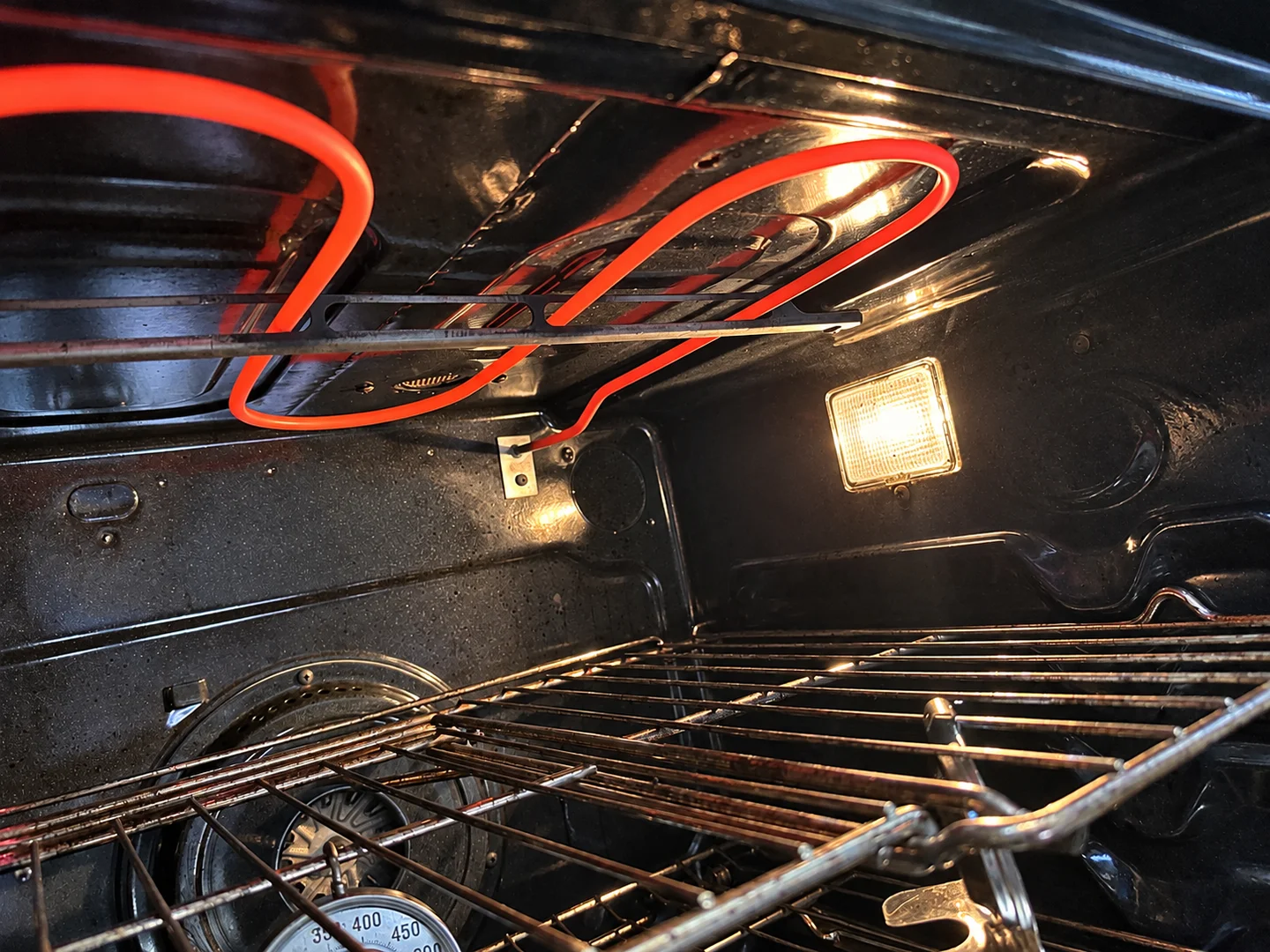
- Relay board. On dual-fuel ranges and wall ovens a stuck relay leaves an element heating with the oven off; an open one leaves no heat. The four-digit code tells us which.
- Sensor and high limit. An open RTD sensor or a tripped thermal cutout stops baking mid-cycle.
- Door hinges and latch. The heavy door wears its hinges until it drops or gaps, and the self-clean latch motor can stall.
How an oven or range repair visit goes
What breaks in Wolf cooktops and rangetops
- Spark switches behind the knobs. Each Wolf gas valve carries a switch that tells the module to spark. Spills make it stick, and the cooktop clicks with the burners off; we replace the switch, not the valve.
- Stiff or leaking valves. A knob that binds, or a dual-stacked burner that will not hold a low simmer on its lower tier, points to the valve.
- Induction and electric models. Wolf induction cooktops report overheating, cooling fan and generator board faults; radiant models lose elements and controls.
How a cooktop repair visit goes
What breaks in Wolf microwaves
- Drawer will not open or close. Wolf microwave drawers move on a motor and gear track; a worn gear, a bent track or a failed drawer motor stalls them.
- Runs but does not heat. We discharge the high-voltage circuit, then test the magnetron, diode and capacitor.
- Interlock switches. These tell the Wolf control the drawer is closed; a worn one blows a fuse or shuts the unit down.
- Convection models. Wolf convection microwaves add an element and fan that fail independently of the microwave side.
How a microwave repair visit goes
What breaks in Wolf hoods and downdrafts
- Blower motors. Wolf pro hoods run internal or remote blowers; worn bearings hum or rattle, and a weak capacitor slows the motor.
- Downdraft lift. The Wolf downdraft rises behind the cooktop on a motor and gear drive; a failed motor, gear or limit switch leaves it stuck up or down.
- Controls and lights. Switch panels and light sockets sit in the heat and grease path and fail first.
- Loaded filters. Greasy filters make the blower louder and weaker, so cleaning comes before motor work.
How a range hood repair visit goes
Parts and warranty on Wolf repairs
We install OEM Wolf parts only, ordered through the parts channel Wolf shares with Sub-Zero. Igniters, spark modules, spark switches and oven sensors are usually easy to get. Relay boards and control panels for older Wolf ovens are sometimes superseded, which can add a few days, and the written estimate says so. If your Wolf is still under the manufacturer's warranty, contact Wolf first; we do not perform warranty repairs. Our repairs carry a 90-day labor warranty.
Wolf codes we see most often
These are the display codes that bring us the most Wolf calls. The wording is ours, and the meaning can shift between model years, so treat the table as a starting point: a technician confirms the cause with tests before any part is replaced.
| Code | What it usually points to |
|---|---|
| 0021 | Bake element relay stuck closed, upper or single oven; relay board fault |
| 1021 | Bake element circuit open, upper or single oven; element, wiring or relay |
| 4221 | Broil element load missing, upper or single oven; often a burned-out element |
| 3221 | Oven temperature sensor reads open, upper or single oven |
| 3311 | Thermal cutout opened in upper or single oven; overheating or wiring |
| 3421 | Door latch motor ran too long without finding its position |
| 3521 | Door opened or latch unlocked during self-clean, upper or single oven |
| 5521 | Oven cooling fan turning below its minimum speed |