

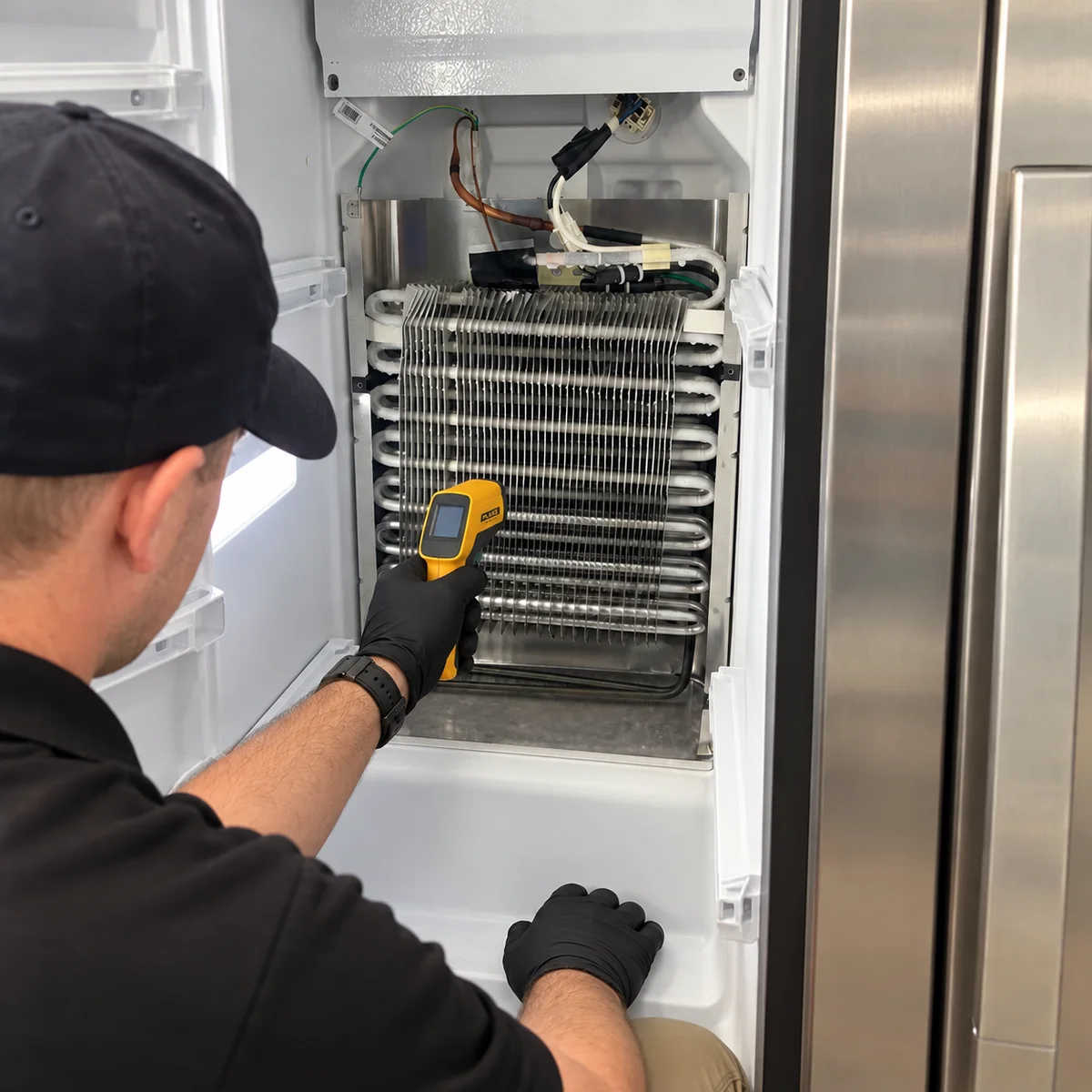

GE, Profile and Café are one engineering family. The premium lines share cabinets, sealed systems and control architecture with standard GE models, so a Café French door refrigerator and a Profile model often use the same inverter board, air damper or ice maker, and GE service documentation is thorough.
Most GE calls we take come down to a short list of parts: compressor inverter boards on French door refrigerators, mode shifters and lid locks on top-load washers, and oven sensors and relay boards on ranges. GE parts are widely stocked, so a confirmed repair rarely waits long for parts.
What breaks in GE refrigerators
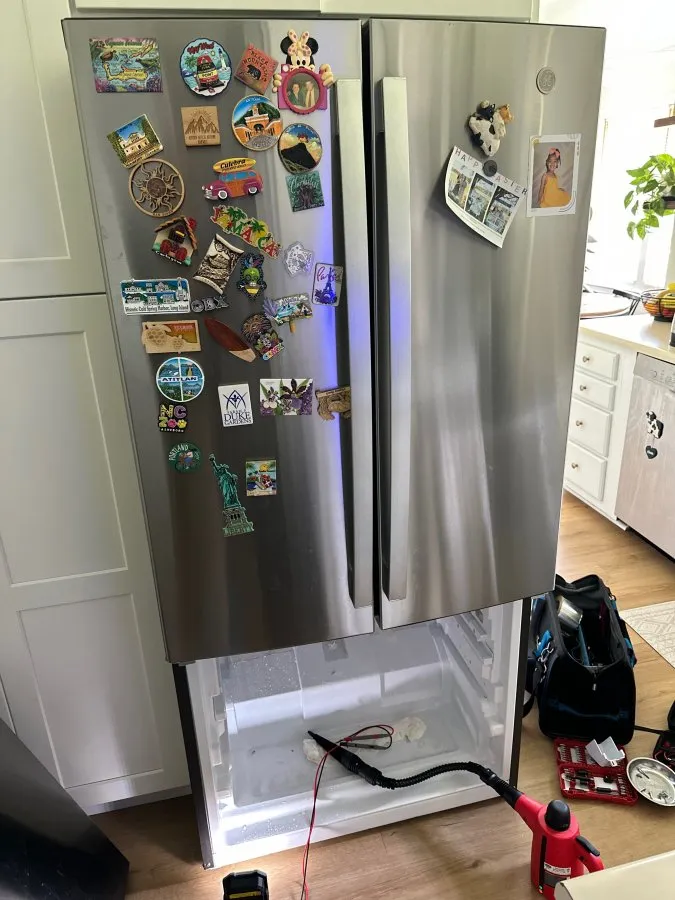
- Compressor will not start: on Profile and Café French door models, the variable-speed compressor runs from a separate inverter board, and a failed board looks like a dead compressor, so we test both.
- Fresh food warm, freezer fine: on models with a separate fresh food evaporator, a slow leak there is common; we repair it in the home as sealed-system work.
- Frost on the freezer back panel: a defrost heater, defrost thermostat or frozen drain.
- Ice maker quits: the ice maker module or a frozen fill tube.
How a refrigerator repair visit goes
What breaks in GE washers
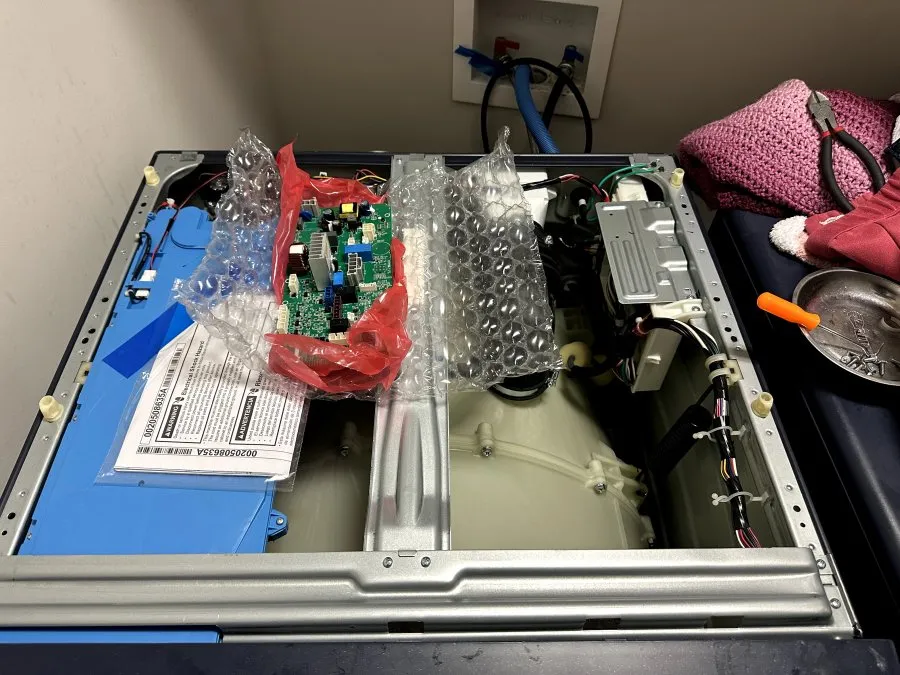
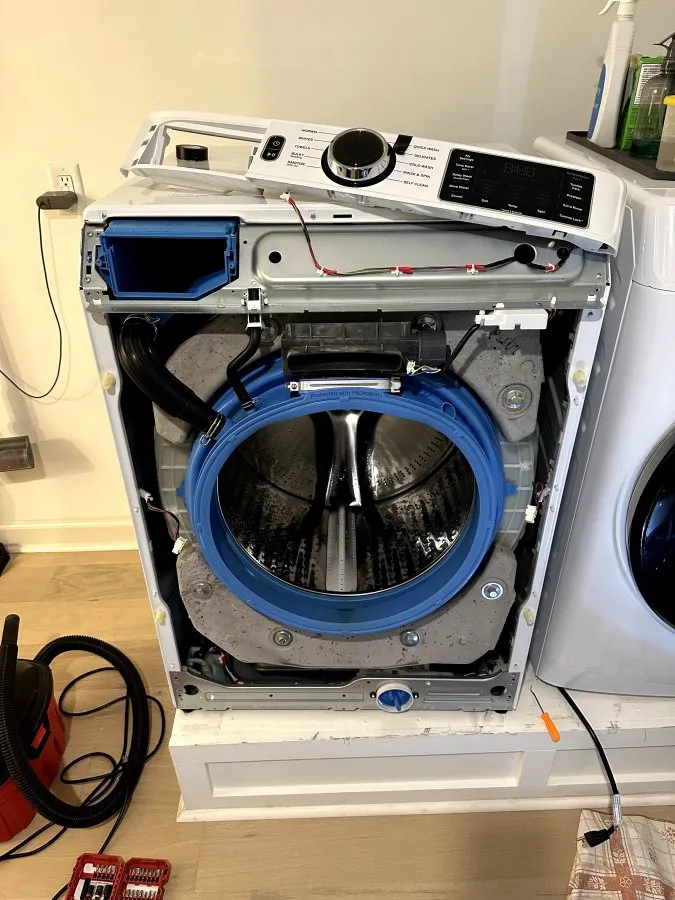
- Agitates but will not spin: GE top-loaders switch between agitate and spin with a mode shifter. When it fails the washer sticks in one mode, and the shifter is replaced as an assembly.
- Lid lock faults: the switch inside the lock stops reporting a locked lid, so the control halts the cycle.
- Tub bangs in spin: worn suspension rods let the tub hit the cabinet; we replace them as a set.
- Water left in the tub: a sock jammed in the drain pump or a failed pump motor.
How a washer repair visit goes
What breaks in GE dryers
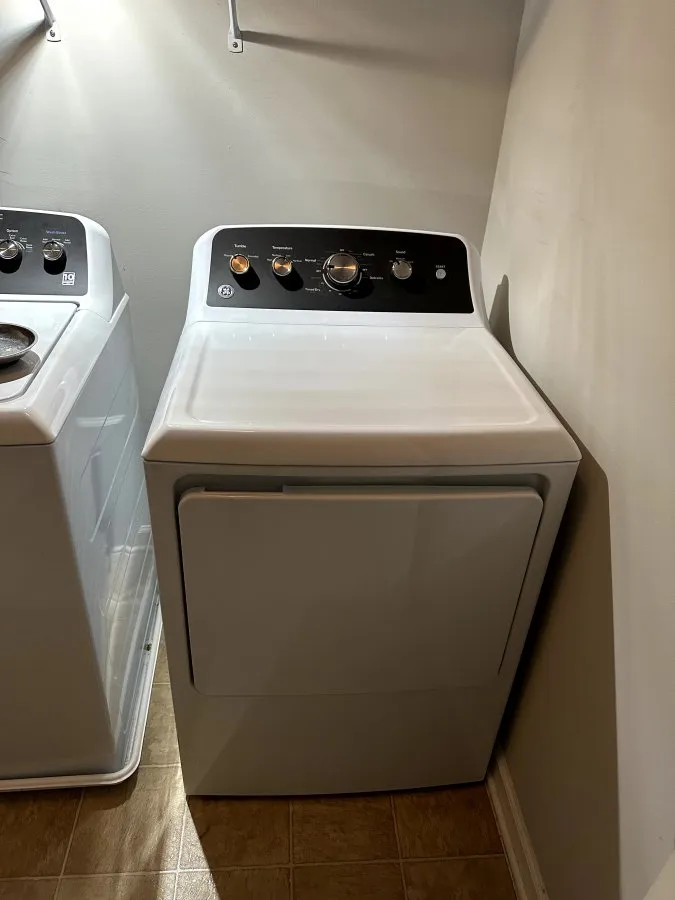
- No heat, electric: the heating element coil breaks, and the thermal fuse often blows with it because both react to restricted airflow. We replace what failed and check the exhaust path.
- No heat, gas: weak gas valve coils let the igniter glow, then shut off without lighting the burner.
- Thumping or squealing: GE drums ride on two rear rollers and slides at the front, and the idler pulley that keeps the belt tight wears along with them.
- Motor runs, drum does not turn: a broken belt, usually with a worn idler.
What breaks in GE dishwashers
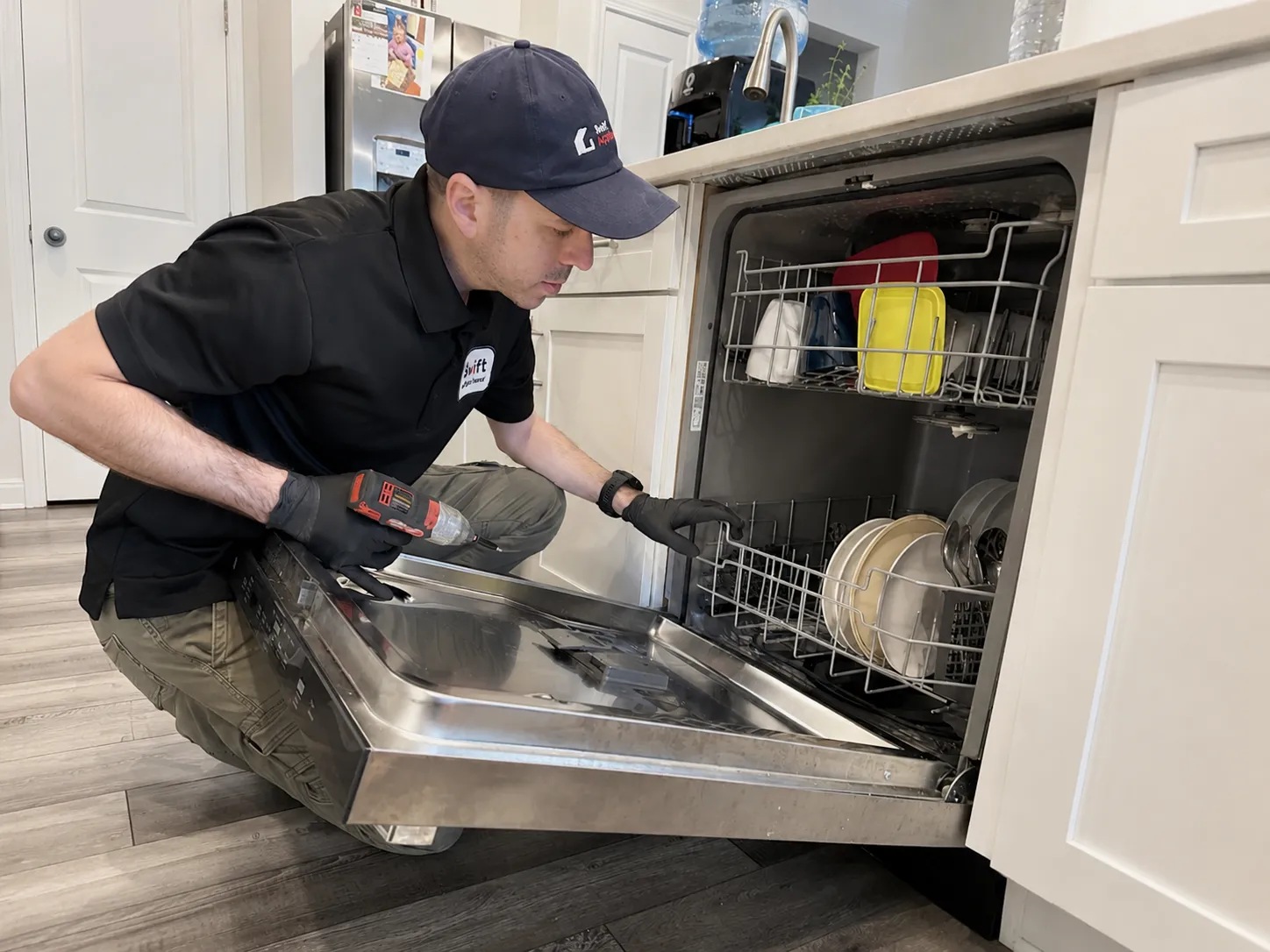
- Dead panel or cycle stops partway: the main control board or the door touchpad. We test which one failed, since GE sells them as separate parts.
- Water left in the bottom: debris in the drain pump or a pump motor that hums without turning.
- H2O on the display: no water is reaching the tub, which points to the inlet valve, the supply or a stuck float switch.
- Dirty dishes: newer GE models use a removable fine filter that cuts spray pressure when it is not cleaned; older models grind food with a hard food disposer. A weak circulation pump gives the same symptom.
How a dishwasher repair visit goes
What breaks in GE ranges and wall ovens
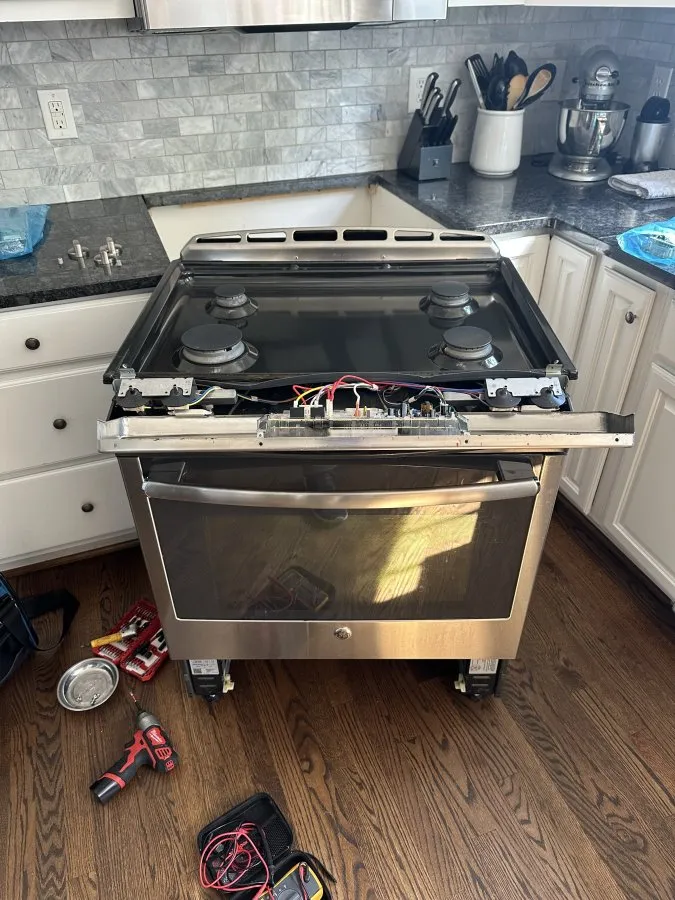
- Oven will not heat: a failed bake element on electric models, or a weak gas igniter that never draws enough current to open the safety valve.
- F2 or F3 on the display: F3 means the sensor circuit reads open, so we check the sensor and its harness with a meter; F2 means the oven overheated, often from a relay stuck closed on the control board.
- Locked after self-clean: the door lock motor or its position switch has failed.
- Loud convection fan: on Profile and Café wall ovens, the fan motor bearing wears out.
How an oven or range repair visit goes
What breaks in GE cooktops
- Radiant element stuck on or off: the infinite switch behind the knob burns its contacts, or a relay sticks on touch-control models.
- Burner keeps clicking: moisture from a boil-over or a cracked spark switch keeps the igniter firing. We dry and test the circuit, then replace the switch or spark module.
- Yellow, lazy flame: a burner cap seated off-center or a partly blocked orifice.
- Induction zone ignores the pan: on Profile and Café induction, that zone's generator board or coil sensor.
How a cooktop repair visit goes
What breaks in GE microwaves
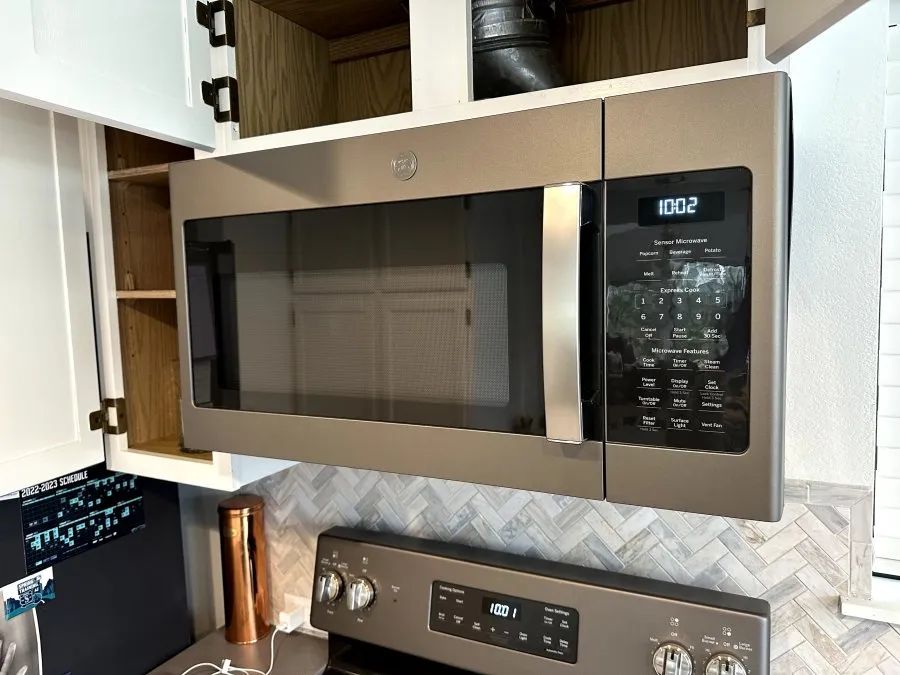
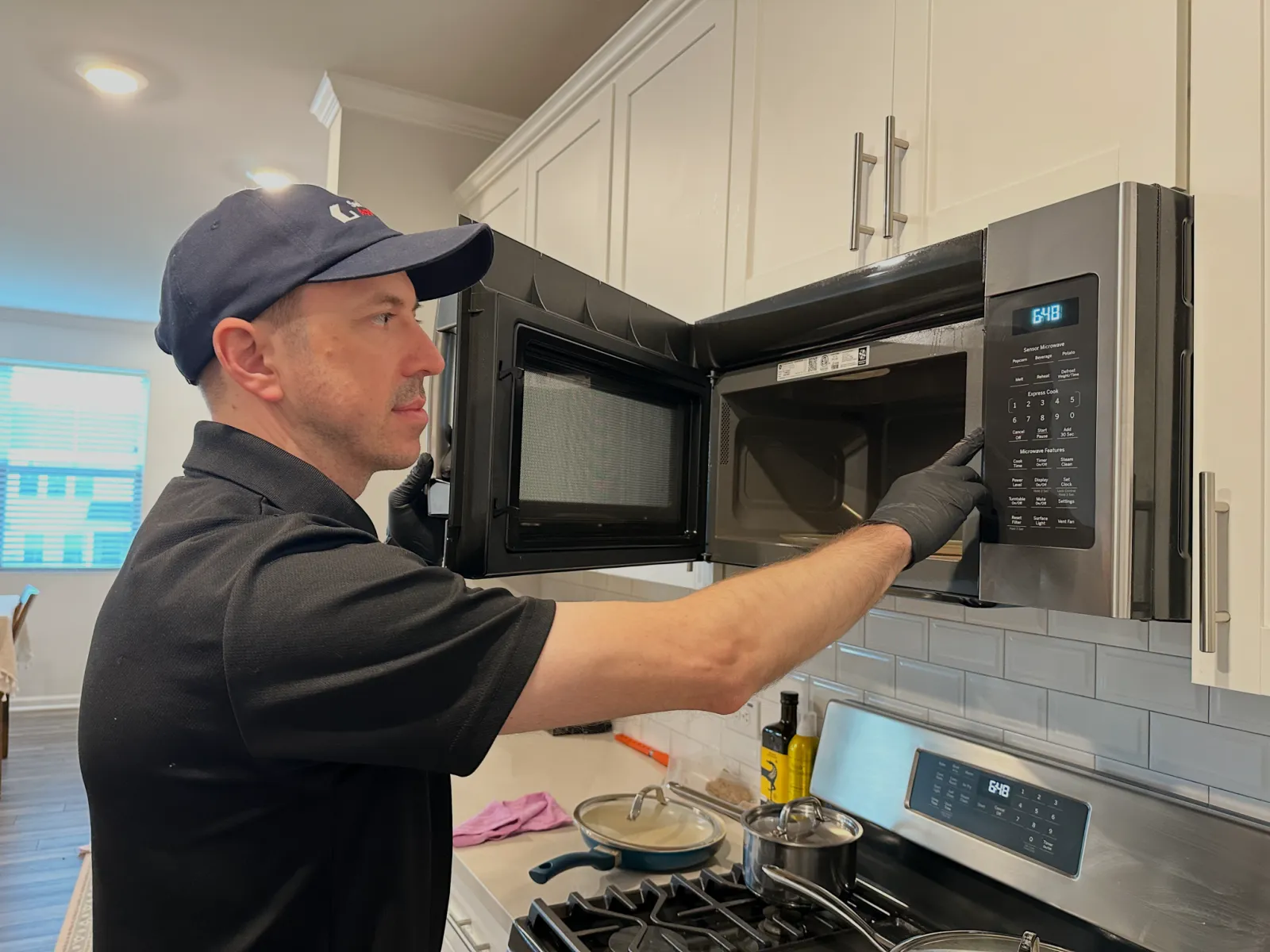
- Runs but does not heat: a failed magnetron, high-voltage diode or capacitor on GE over-the-range models. We test all three, because one failure can take another part with it.
- Completely dead: a blown line fuse, often caused by a failing door switch.
- Advantium not browning: the halogen heating lamps or their relay on the control board.
- Keys not responding: the membrane touchpad wears out with heavy use.
- Noisy vent fan: a worn fan motor bearing.
How a microwave repair visit goes
What breaks in GE range hoods
- Blower dead or stuck on one speed: the blower motor or the speed control board in GE and Café wall-mount and under-cabinet hoods.
- Hood no longer starts with the cooktop: GE's Chef Connect pairing has dropped, or the hood control board has failed.
- Rattle at high speed: grease buildup throws the blower wheel off balance; we clean or replace the wheel.
- Weak draw: a backdraft damper stuck partly closed.
- Lights out: the LED module or its switch.
How a range hood repair visit goes
Parts and warranty on GE repairs
We install OEM GE parts only, so a Profile inverter board or a Café ice maker fits and behaves like the original. Elements, sensors, valves and pumps are widely stocked; control boards and sealed-system parts for less common models can take longer to arrive. If your GE appliance is still under the manufacturer's warranty, contact GE Appliances first, since that repair is theirs. Our repairs carry a 90-day labor warranty.
GE codes we see most often
These are the display codes that bring us the most GE calls. The wording is ours, and the meaning can shift between model years, so treat the table as a starting point: a technician confirms the cause with tests before any part is replaced.
| Code | Appliance | What it usually points to |
|---|---|---|
| F1 | Oven & range | Oven control board failed its internal self-check; the board usually needs replacing |
| F2 | Oven & range | Oven ran hotter than its safe limit; sensor, stuck relay or control board |
| F3 | Oven & range | Oven temperature sensor circuit reads open; sensor or its wiring |
| F4 | Oven & range | Oven temperature sensor circuit reads shorted; sensor or pinched harness |
| F7 | Oven & range | A touchpad key reads as held down; membrane keypad or ribbon cable |
| F9 | Oven & range | Self-clean door lock did not reach position; lock motor or switch |
| H2O | Dishwasher | No water detected in the tub; supply, inlet valve or float switch |