



Hotpoint is the value line of GE Appliances, built alongside GE models and sharing many of their parts. The lineup is deliberately plain: top-freezer refrigerators, top-load washers, electric and gas dryers, basic built-in dishwashers and ranges with coil or smooth-top elements. Controls are mostly knobs, mechanical timers, simple thermostats and basic electronic boards.
That simplicity works in your favor. There are fewer boards to fail, the mechanical parts are the same ones GE has used across many models, and they are easy to find. Most Hotpoint failures we see are wear items: defrost components, drive parts, heating elements and switches.
What breaks in Hotpoint refrigerators
Most Hotpoint refrigerators we see are top-freezer models.
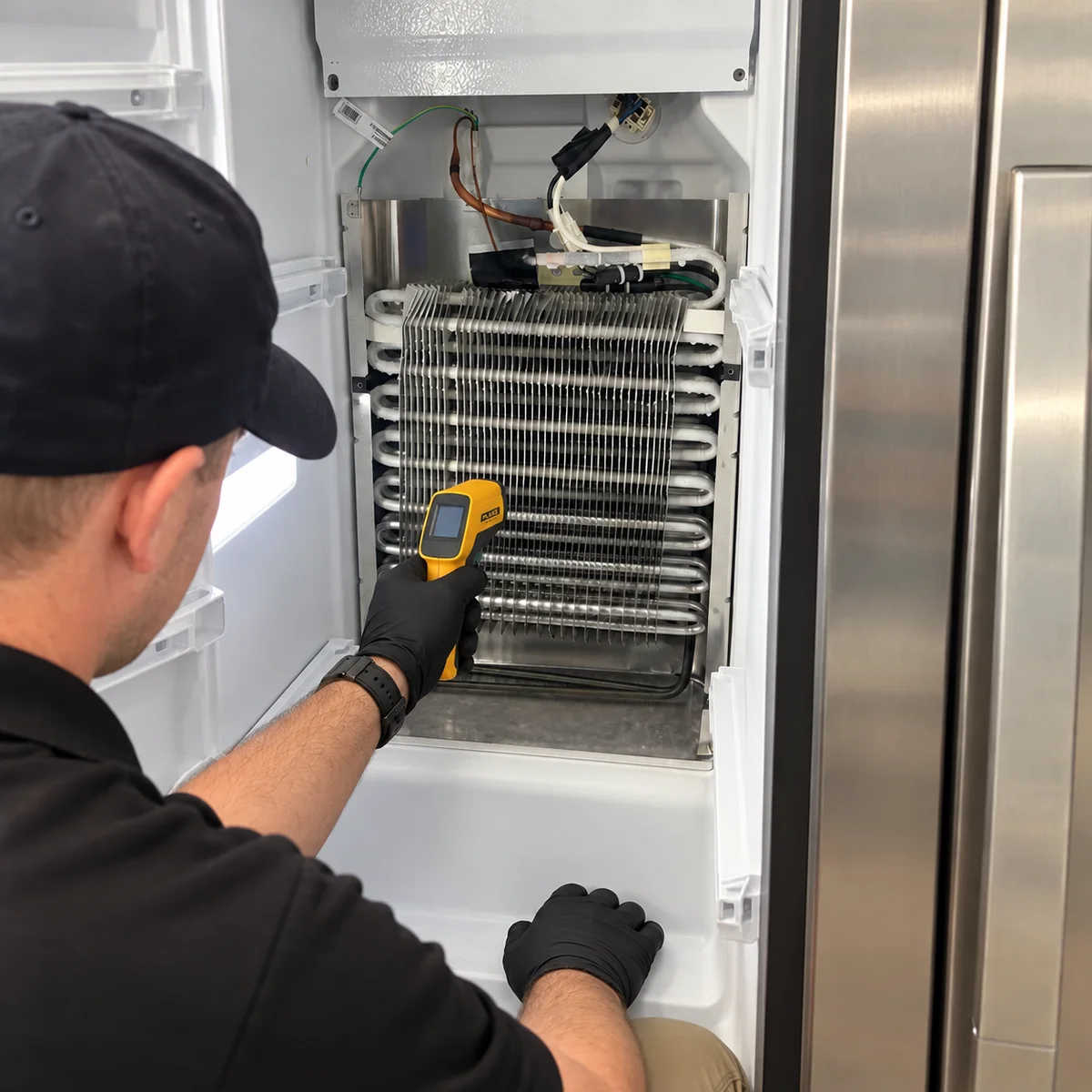
- Freezer cold, fresh food warm: the defrost system has failed, and the evaporator behind the freezer panel has turned into a block of frost that air cannot pass. The cause is a defrost heater, defrost thermostat, or the defrost timer or control.
- Clicking, compressor not running: a failed start relay on the compressor.
- Both sections warm: a stopped condenser fan or evaporator fan motor.
- Too cold or too warm: a worn cold control thermostat.
How a refrigerator repair visit goes
What breaks in Hotpoint washers
- Agitates but will not spin: newer Hotpoint top-loaders use the same mode shifter as GE models, and a failed shifter leaves the washer stuck in one mode.
- Motor runs, basket stays still: the basket drive hub wears and strips, so the drive turns without catching the basket.
- Top of the agitator stops ratcheting: on dual-action agitators, the one-way clutch inside the upper section wears out.
- Will not start: a broken lid switch, or worn timer contacts on mechanical-dial models.
How a washer repair visit goes
What breaks in Hotpoint dryers
- No heat: the heating element coil breaks or the thermal fuse blows, often both, because a long or crushed exhaust run makes the dryer overheat. We replace the failed parts and show you where airflow is restricted.
- Drum does not turn: a snapped belt, usually with a worn idler pulley.
- Thumping: flat-spotted drum rollers or worn felt slides at the front.
- Will not start: the door switch, the start switch or the mechanical timer.
What breaks in Hotpoint dishwashers
- Dishes wet or cold at the end: most Hotpoint dishwashers heat with an exposed element under the lower rack, and when it burns open the water and dishes stay cool.
- Water left in the tub: a clogged drain path or a failed drain pump.
- Not filling: the water inlet valve or the float switch.
- Lights blink and nothing runs: the door latch switch or the basic control board.
- Leaks at the door: a worn door gasket or bottom seal.
How a dishwasher repair visit goes
What breaks in Hotpoint ranges
- Coil burner dead or stuck on one setting: the burner receptacle burns and loosens, or the infinite switch behind the knob wears out. A pitted burner terminal ruins a new receptacle, so a damaged burner and receptacle are replaced together.
- Oven not heating: a burned-out bake element on electric models or a weak igniter on gas.
- F2 or F3 on the clock: F3 means the oven sensor reads open, usually the sensor or its connector; F2 means the oven ran too hot, often from a relay stuck closed on the control.
- Door stuck locked: the lock motor on self-clean models.
How an oven or range repair visit goes
Parts and warranty on Hotpoint repairs
We install OEM parts only, and for Hotpoint that means GE Appliances parts, since the two brands share most components. Heating elements, defrost parts, drive parts, switches and sensors for Hotpoint are widely stocked and usually arrive quickly. Older mechanical timers are the exception, as some have been discontinued. If your Hotpoint is still under the manufacturer's warranty, contact GE Appliances first, since that repair is theirs. Our repairs carry a 90-day labor warranty.
Hotpoint codes we see most often
These are the display codes that bring us the most Hotpoint calls. The wording is ours, and the meaning can shift between model years, so treat the table as a starting point: a technician confirms the cause with tests before any part is replaced.
| Code | What it usually points to |
|---|---|
| F1 | Range control board failed its self-test; the electronic control needs replacing |
| F2 | Oven temperature climbed past its limit; sensor or stuck relay |
| F3 | Oven sensor reads an open circuit; failed sensor or loose connector |
| F4 | Oven sensor reads a short; failed sensor or damaged wire |
| F7 | Control sees a key held down; worn keypad or its connector |
| F9 | On self-clean models, the door lock failed to engage or release |