Quick Answer
First, make sure the freezer door closes fully and food is not blocking the vents. Door gaps and poor airflow are common reasons a freezer softens food. Dusty condenser coils can also make it harder for the refrigerator to cool.
A brief temperature rise after opening the door or during automatic defrost can be normal. Food thawing and refreezing is not. Check the temperature with a freezer thermometer rather than relying on a momentary display reading.
Most Likely Causes
Door gap or damaged seal
A package or bin can hold the door slightly open. Frost near the opening and food softening near the door often point here. Clear the obstruction and wipe the gasket. A torn gasket or door that will not line up needs service.
Blocked interior vents
Tightly packed food can restrict cold-air circulation. Some areas may stay frozen while others soften. Move packages away from visible vents and give the freezer time to recover.
Dusty condenser coils or blocked exterior airflow
Dust buildup makes heat harder to release, especially if both the freezer and refrigerator are warm. Cleaning coils you can reach without removing a cover is a homeowner check. Inaccessible coils should be left alone.
Freezer fan not moving air
An evaporator fan problem can leave food warm even while the freezer is producing cold air. Unusual scraping or uneven cooling can be clues. Some fans stop when the door opens, so silence with the door open does not prove failure. Fan diagnosis needs service.
Frost blocking airflow behind the back wall
Heavy frost across the freezer's inside back wall often points to a defrost problem. Cooling may improve briefly, then fade as ice builds again. Do not chip ice or remove the panel to check it.
Cooling-system problem
If the doors, vents, and accessible coils are clear but the freezer still cannot reach 0°F, a compressor or sealed-system problem is possible. This is less useful to guess at from a sound alone and needs diagnosis.
Safe Checks to Do First
- Check the setting. Aim for 0°F. After a setting change or large grocery load, allow about 24 hours to see where the temperature settles.
- Check that food and bins do not push on the door. Wipe the gasket with a damp cloth and look for gaps or tears.
- Clear visible interior vents. Unplug the refrigerator before vacuuming an accessible front grille or exposed coils. Do not remove covers or pull a heavy refrigerator out to reach them.
- Place a freezer thermometer near the middle, away from the door. Check it over the next day and note whether food is softening.
Discard perishable food held above 40°F for more than 2 hours, or if you cannot tell how long it was that warm. Do not taste it to decide.
What the Symptoms Usually Mean
Freezer temperature fluctuates up and down
Short air-temperature swings most often reflect a door opening or defrost cycle. Repeated swings that soften food point more often to a door seal, airflow, fan, or defrost fault.
Heavy frost on the back wall
A broad layer of frost most often points to a defrost problem restricting airflow. Frost concentrated around the door points more toward a gap in the seal.
Freezer is cold but refrigerator is warm
That pattern most often points to restricted airflow into the fresh-food section. See the checks for a refrigerator not cooling.
Both compartments are warm
This most often calls for checking exterior airflow and accessible coils first. If those are clear, the cause may be a fan or cooling-system fault.
When to Stop DIY and Call a Technician
Arrange refrigerator repair service if food keeps softening after the safe checks, frost returns across the back wall, or you hear scraping from inside the freezer. Disassembly, live electrical testing, and sealed-system repairs are technician work. If you smell burning, unplug the refrigerator if you can do so safely. If a breaker trips again after one reset, leave it off and call for service.
From Our Repair Log
October 2026: Whirlpool Refrigerator Not Cooling. Diagnosis in Wake Forest
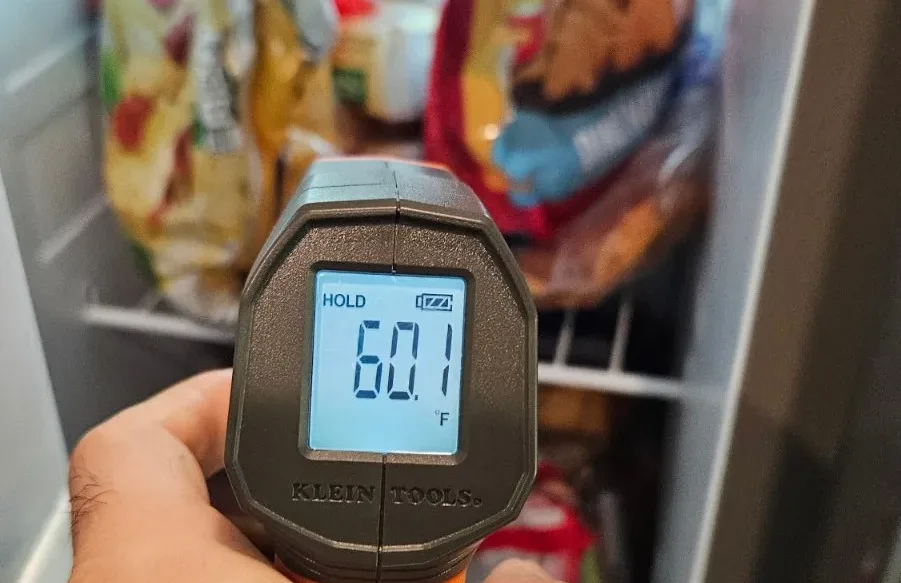
Temperatures in both compartments were above 60°F, while the evaporator cover measured about 20°F. The evaporator fan was not running despite receiving the correct 120V supply.